Generative Engine Optimization has a measurement problem, and that is why this category exists.
In traditional SEO, Search Console tells you where you rank and what people clicked. In generative search, none of that exists. The answer is composed fresh each time, and whether your brand appears in it is invisible from your own analytics.
The gap is widening. Ahrefs measured the share of AI Overview citations that also rank in Google’s top 10 falling to 37.9% in March 2026, down from 76.1% eight months earlier. Your rankings can hold perfectly while your visibility in the answers collapses, and your reporting will show nothing.
GEO tools exist to make that surface measurable. They run prompt sets across engines at intervals and record whether you are cited, how prominently, and how your brand is described.
Four criteria separate the ones worth paying for.
Engine coverage, because a page cited by ChatGPT may be absent from Gemini entirely. Methodology transparency, since results depend on which prompts are sampled and how often. Actionability, because knowing your citation rate dropped is a dashboard, while knowing which pages to fix is a tool. And integration with traditional SEO, since crawlability and structure still feed both surfaces.
This ranking applies those four criteria. It opens with Pushrank, which treats generative visibility as part of SEO rather than as a separate discipline with its own dashboard.
1. Pushrank
Most tools in this category were built to answer one question: are we cited by AI engines? Pushrank was built to answer a harder one: what should we do about it.
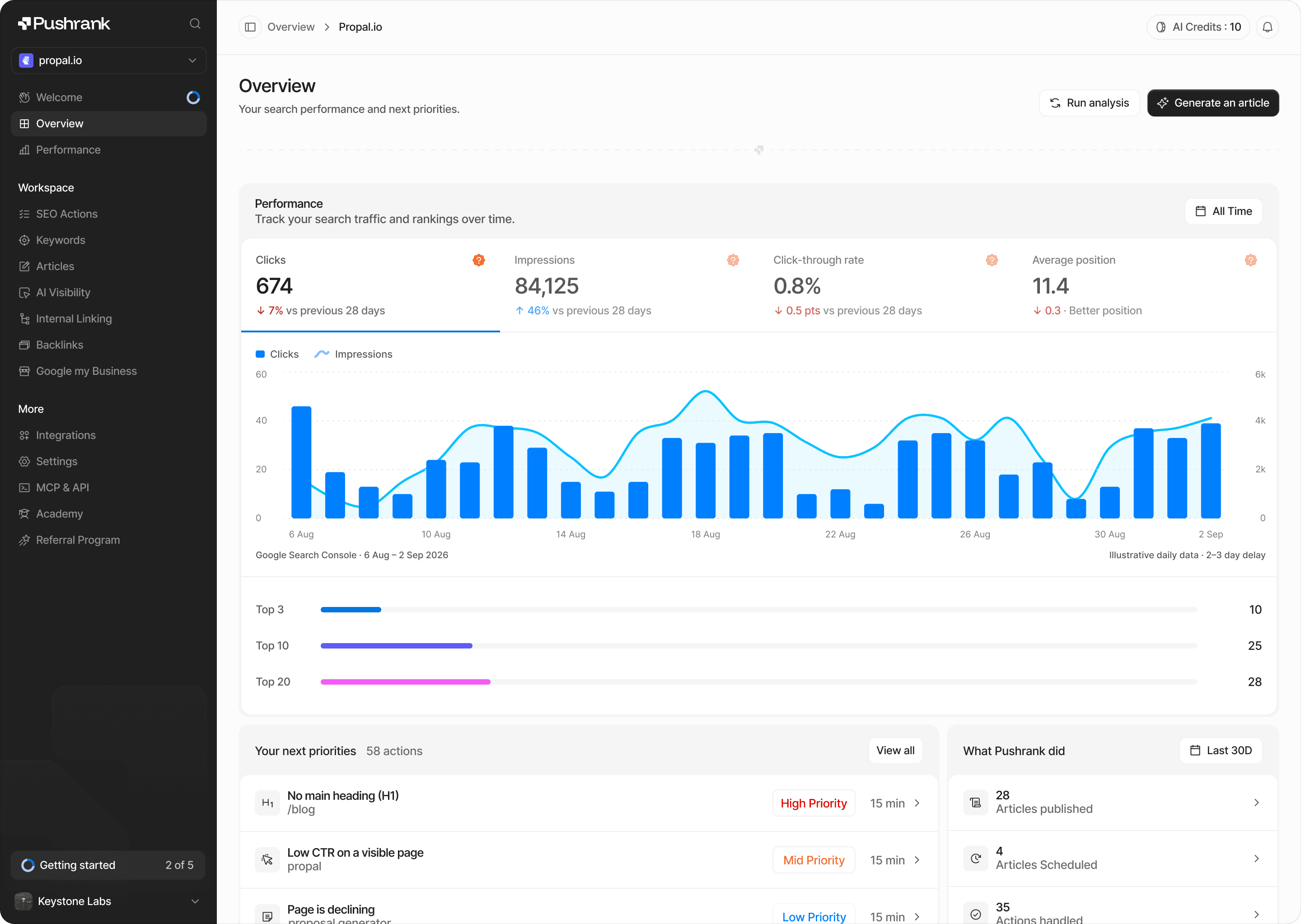
The platform tracks visibility across ChatGPT, Claude and Gemini alongside traditional rankings, in a single view. That combination is the point. Generative citations and organic positions respond to overlapping signals, and separating them into two dashboards produces two reports that nobody reconciles.
What distinguishes it operationally is the prioritized daily action plan. Rather than presenting metrics and leaving interpretation to you, the tool orders what to fix first. For teams without a dedicated SEO lead, this is the difference between data and progress, and it is the complaint most frequently levelled at pure monitoring platforms.
Alongside it sit the SEO actions, a set of recommendations refreshed every week and framed as a guide to outranking your specific competitors rather than as generic best practice. The refresh cadence matters in a surface where retrieval indexes shift continuously.
The foundation remains conventional, which is appropriate. Pushrank runs a technical audit, connects to Search Console for first-party performance data, and detects keyword cannibalization, the problem that quietly suppresses both rankings and citations when several of your pages compete for the same intent.
Content production is included rather than outsourced to another subscription, with 30 articles per month generated against the action plan.
An MCP integration completes the stack, letting you query your own SEO data directly from Claude or ChatGPT instead of navigating the interface.
Pricing starts at €74 excl. VAT per month on annual billing, or €89 monthly, with a 7-day free trial.
Its limitation is scope-related rather than functional. Pushrank covers the three assistants most businesses care about, so teams needing exhaustive coverage across every emerging engine, including Perplexity and regional models, will want to check the current list against their market.
Best for businesses that want generative visibility handled as part of their SEO rather than as a separate reporting exercise, and teams who need to be told what to do next.
2. Profound
Profound is the enterprise benchmark in this category, and the one most teams compare everything else against.
It raised a $96M Series C at a $1 billion valuation in February 2026, led by Lightspeed Venture Partners, bringing its total funding to around $155M. It reports serving more than 1,000 enterprise brands.
Engine coverage is its clearest advantage. The platform tracks how often a brand appears in ChatGPT, Perplexity, Claude, Gemini and Google AI Overviews, and Enterprise tiers extend to nine or ten engines including Copilot, Grok, Meta AI and DeepSeek. For a global brand that cannot afford blind spots, nothing else matches that breadth.
Three features define the product.
Answer Engine Insights is the core monitoring layer, covering share of voice, sentiment and how your brand is characterized when it appears rather than simply whether it does.
Prompt Volumes is the differentiator competitors struggle to replicate. It is a dataset built on over a billion real AI conversations, showing what people actually ask engines rather than what keyword tools infer they search. Reviewers note the data remains inconsistent in places, but the direction is right: generative queries do not resemble search queries, and estimating them from volume data is guesswork.
Agent Analytics tracks AI crawler traffic hitting your site, which is the closest thing to first-party data this category offers.
Pricing is the main barrier. Profound does not publish rates, and third-party reviews in early 2026 placed enterprise deployments between $2,000 and $5,000+ per month depending on platform count, seats and features. A Growth tier has been reported around $332 per month, though published figures vary enough that a demo is required to know your actual cost.
One caveat applies here and across the whole category. Attribution from AI-answer mentions to downstream revenue remains methodologically immature, so treat visibility metrics as leading indicators rather than as proven revenue drivers.
Best for enterprise brands with a dedicated GEO function, the budget to match, and a need for coverage across every engine rather than the main three.
3. Peec AI
Peec AI is the tool most agencies land on when Profound’s pricing proves unrealistic and they still need serious coverage.
Founded in 2025 and based in Berlin, the company raised a $21M Series A led by Singular in late 2025 and has grown unusually fast since, with revenue estimates placing it around $20M ARR by late 2026. Several thousand brands and agencies now use it, with a strong European base expanding internationally.
The product keeps a deliberately simple loop: define your prompts, watch your visibility, act on the citations that matter. Where enterprise platforms bury you in modules, Peec stays legible, and teams get to a working setup within an afternoon.
It tracks visibility, position, sentiment and sources against named competitors, which is the reporting shape most marketing teams actually need. Share of voice against three rivals, measured weekly, answers more executive questions than a raw citation count ever will.
Two things make it the agency favorite.
Multi-brand management on a single invoice, rather than per-client contracts, which matches how agencies are actually structured. And a Looker Studio connector, so AI visibility slots into client reporting that already exists instead of becoming another login to share.
Language coverage is another strength, with well over a hundred languages tracked, a genuine differentiator for European and multi-market work.
Pricing is published, which is rarer than it should be in this category. Self-serve brand plans start around €85 to €95 per month, with a Pro tier near €205 for a larger prompt allocation, and agency plans starting higher. Annual billing applies roughly a 15% discount.
Two limitations deserve attention.
Plans include a limited number of engines by default, typically three, with additional models billed as add-ons. Teams needing Claude, Gemini, Copilot and Grok simultaneously should price that before comparing headline rates.
The product is also monitoring-first. It tells you where you stand with precision, and does considerably less to tell you what to change. Expect to pair it with your existing SEO workflow rather than replace it.
Best for agencies managing several client brands, and European teams working across multiple languages.
4. Otterly.ai
Otterly.ai is the entry point of this ranking, and the only tool here that a solo consultant or a small brand can realistically start with.
Its Lite plan runs at $29 per month for 15 tracked prompts. That is roughly a tenth of what most competitors charge to begin, and it changes who can participate in GEO at all. For a business testing whether AI visibility matters to its category before committing budget, this is the cheapest serious answer available.
Engine coverage is more generous than the price suggests. The platform monitors six engines: ChatGPT, Google AI Overviews, Google AI Mode, Gemini, Perplexity and Microsoft Copilot. Several tools charging far more include fewer by default.
The feature set covers the fundamentals properly. Brand mentions and ranking, average position within answers, sentiment analysis, and link citation tracking, which identifies not only whether you are mentioned but whether the engine sent a link. That distinction matters, since a mention without a citation builds awareness while a citation builds traffic.
Country and language-level monitoring is included, revealing performance variations between markets that an aggregate score hides entirely. The company’s public pages quote slightly different coverage figures depending on where you look, so verify your exact country and engine combination during the trial rather than trusting the headline number.
Two additions push it beyond pure monitoring. Content crawlability audits check whether your key pages are reachable by AI crawlers, and AI crawler analytics show which bots are actually visiting your site.
Pricing scales steeply with prompt volume. The published tiers run from $29 for 15 prompts to $189 for 100 and $489 for 400. The jump from Lite to Standard is where most growing users feel the constraint, since 15 prompts covers one product line and little else.
Its limitation is depth rather than breadth. Otterly reports your position clearly and does comparatively little to explain what to change, which means it pairs well with an existing SEO process and poorly with none.
Best for small teams, consultants and brands starting GEO measurement without an enterprise budget.
5. Semrush AI Toolkit
Semrush entered this category from the opposite direction to everyone else. Rather than building an AI visibility product and adding SEO context later, it bolted generative tracking onto the largest SEO platform in the market.
For teams already paying for Semrush, that is the entire argument. You add AI visibility without onboarding a new vendor, training a team on a second interface or reconciling two sets of reporting.
Coverage spans the engines that matter commercially: Google AI Overviews, Google AI Mode, ChatGPT, Perplexity, Gemini and Copilot.
The reporting is organized around business questions rather than raw metrics. Business Landscape reports show AI market share against competitors, Brand and Marketing reports handle sentiment, and Audience and Content reports surface the query themes driving mentions. Competitive tracking extends to a large number of rivals, and outputs export as shareable slides, which matters more for agencies than any feature list suggests.
The toolkit also generates recommendations rather than stopping at measurement, and an AI-ready site audit checks whether your pages are accessible to AI crawlers.
Pricing comes in two shapes. A standalone AI Visibility Toolkit starts around $99 per month per domain on annual billing, tracking a limited set of custom prompts. The broader Semrush One bundles combine classic SEO with AI visibility, starting near $199 per month and scaling to $549 at the Advanced tier, where prompt tracking and site allowances increase substantially.
Two limitations deserve weighing.
The prompt methodology relies largely on a synthetic prompt database generated per domain and location, rather than on observed user conversations. It is a reasonable proxy, and it is not the same thing as knowing what people actually asked.
Prompt volume is modest at entry level compared with dedicated platforms at similar prices. If deep prompt-level analysis is your priority, specialists go further.
Semrush’s strength here is integration, not depth. For most mid-market teams, that trade is the right one.
Best for existing Semrush customers and mid-market teams who want AI visibility reported alongside rankings without adding a vendor.