Claude is useful for SEO in the places where the work is thinking, writing and analysing, and much less useful where the work is live ranking data. That distinction matters more than any prompt you will find online.
Where it genuinely performs: clustering a keyword list by intent, turning a SERP analysis into a content brief, auditing an existing page against the query it targets, drafting and restructuring content, generating schema markup, writing the Python or regex you need to clean a Search Console export, and spotting cannibalisation across a set of URLs you give it.
Where it does not replace anything: Claude has no search volume, no keyword difficulty, no backlink index and no live position data. It analyses what you feed it. Ask it for a search volume and you will get a plausible number that is simply invented.
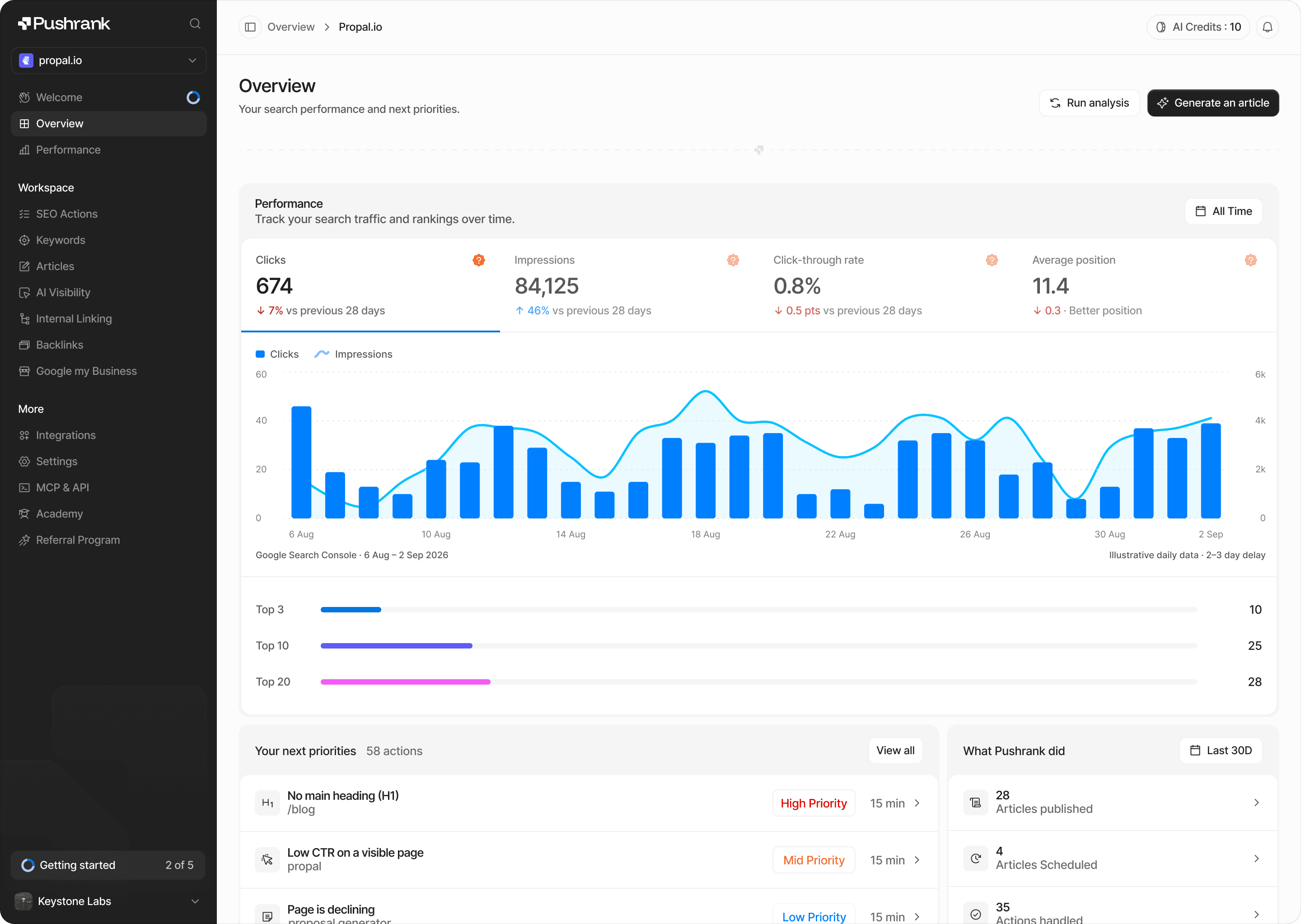
The practical approach is therefore a split one. Your SEO tools supply the data, Claude supplies the reasoning and the production. That is also how Pushrank is built: real crawl and Search Console data on one side, AI-generated briefs and prioritised actions on the other, so you never have to choose between accurate numbers and useful output.
Here is how to put that into practice, task by task.
What SEO tasks is Claude actually good at?
Claude is strongest on tasks where the input is text or data you already hold, and the output is a judgment, a structure or a draft. Six use cases stand out.
Keyword clustering and intent mapping. Paste 500 keywords exported from your tool of choice and Claude will group them by intent and by target page. This is the single biggest time saver in the list, and it directly prevents cannibalisation.
Content briefs. Give it the top 10 SERP results for a query and it will extract the common angles, the gaps nobody covers, and a heading structure that fits the intent. It reasons well about what a page needs to answer.
Content audits. Feed it an existing page and the query it targets. Claude is reliable at spotting off-intent sections, missing subtopics, thin coverage and headings that answer nothing.
Writing and restructuring. Drafting, rewriting for clarity, tightening, translating a page into another market's language, adapting tone per brand. This is where it is closest to a human output.
Technical scripting. Regex for redirect rules, Python to merge a crawl export with Search Console data, Screaming Frog custom extractions, structured data in JSON-LD. You do not need to be a developer to get working code.
Log and export analysis. Hand it a CSV and ask which URLs lost impressions quarter on quarter, which pages have high impressions and a low CTR, which queries changed intent. It handles this well, provided you give it the file.
The common thread: Claude works on what you give it. It does not fetch your rankings, it does not know your backlink profile, and it does not see what Google sees. Platforms like Pushrank handle that side by crawling your site and pulling Search Console directly, then applying the same reasoning on top of real data.
What SEO tasks should you never trust Claude with?
The failure mode is always the same: Claude will answer confidently even when it has no way of knowing. These are the tasks where that becomes expensive.
Search volumes and keyword difficulty. Ask for the monthly volume of a keyword and you will get a number. It will look credible, it will be rounded sensibly, and it will be invented. There is no volume database behind it. Use your keyword tool, then bring the numbers to Claude.
Your current rankings. Claude cannot see your positions, your competitors' positions, or how either moved last week. Any ranking it states is a guess dressed as data.
Backlink analysis. No link index, no domain authority, no referring domain counts. If you need link data, it comes from a crawler that actually crawls the web.
Live SERP analysis without the SERP. Claude can analyse a SERP brilliantly, but only if you paste it in. Asking "what ranks for this query?" from memory produces plausible-sounding results that may not exist.
Publishing content unedited. The draft will be clean, structured and grammatically perfect. It will also contain generic claims, safe formulations and occasionally a confidently wrong fact. Every statistic, date, price and legal reference needs to be verified before publication.
Anything time-sensitive. Algorithm updates, platform pricing changes, policy shifts: unless Claude searches the web in that same conversation, it is working from a training cutoff. Always ask it to check.
Deciding your priorities blind. Claude can tell you what is theoretically important in SEO. It cannot tell you what matters for your site this month, because it does not know which pages are losing impressions or where your crawl budget is being burned. That requires real data, which is exactly what Pushrank is built to supply before any recommendation is made.
How to write effective SEO prompts for Claude?
Most disappointing outputs come from the prompt, not the model. A vague request produces generic SEO advice; a specific one produces work you can ship. Follow these seven rules.
Give it the data, never ask for it. Paste the keyword export, the SERP results, the Search Console CSV, the current page content. Claude reasons on what you provide. Without input, it fills the gap with plausible invention.
Define the role and the context in one line. "You are an SEO consultant working on a French ecommerce site selling technical workwear to B2B buyers." Industry, market, audience and business model change every recommendation that follows.
State the target query and the intent. One prompt, one keyword, one page. The same discipline that prevents cannibalisation on your site prevents vague output in your prompts.
Specify the output format. Word count, heading levels, table or prose, bullet list or paragraphs. If you do not say it, you will get the default, and the default is rarely what your CMS needs.
Give an example of what good looks like. Paste a page that already performs for you, or a competitor's section you want to beat. Claude matches patterns far better than it follows abstract instructions.
Ask it to flag its uncertainty. Add "mark anything you are not certain about, and never invent a figure." This single sentence removes most of the fabrication risk.
Iterate in the same conversation. Do not restart with a new prompt. Correct, narrow, push back. The context already built is what makes the second output better than the first.
One last habit worth keeping: ask Claude to search the web whenever the answer depends on current prices, dates, regulations or algorithm changes. Without that instruction, it answers from its training data.
Can Claude replace an SEO tool?
No. And the reason is structural rather than a matter of capability: Claude has no data of its own about your site or about the web.
An SEO tool exists to observe. It crawls your pages, pulls your Search Console performance, tracks your positions day after day, indexes backlinks, measures volumes, detects broken links and duplicate titles. All of that requires infrastructure: crawlers, databases, API connections, historical storage. Claude has none of it.
Claude exists to reason. Give it a crawl export and it will tell you which issues actually matter. Give it 500 keywords and it will cluster them by intent. Give it a page and its target query and it will explain what is missing. That is genuine value, and no keyword tool does it well.
The two are complementary, not competing. The practical workflow for most consultants looks like this: the tool produces the data, Claude turns it into decisions and deliverables, and you arbitrate. Removing either side breaks the chain. Without the tool you reason on nothing; without the reasoning you drown in a 4,000-row export nobody reads.
What is changing is that the gap between the two is closing. SEO platforms are embedding the reasoning layer directly, so you no longer copy a CSV from one window into another. Pushrank was built on exactly that premise: it crawls your site, connects to Search Console, and then produces the output an SEO would have written from that data, a prioritised daily action plan and SEO actions refreshed every week, rather than a dashboard you still have to interpret.
So the honest answer is that Claude replaces part of the analyst's work, not the tool. If you were hoping to cancel your subscriptions and run SEO from a chat window, you will be ranking on invented search volumes.
How to combine Claude with your SEO stack?
The principle is simple: every tool in your stack produces data, Claude turns that data into something you can act on. Here is where it slots in, step by step.
With Search Console
Export your query and page performance over two comparable periods and hand the CSV to Claude. Ask which URLs lost impressions, which pages have high impressions and a poor click-through rate, and which queries shifted intent. You get a prioritised list in minutes instead of an afternoon spent in pivot tables.
With your crawler
Screaming Frog, Sitebulb or any crawl export will flag hundreds of issues. Claude's job is triage: separate what actually affects rankings from what is noise, group issues by root cause, and write the ticket descriptions your developer will receive.
With your keyword tool
Pull volumes and difficulty from Semrush, Ahrefs or your preferred source, then let Claude cluster the list by intent and map each cluster to a single target page. This is where the one-keyword-one-page rule gets enforced, and where cannibalisation gets caught before it is published.
With the SERP itself
Paste the top ten results for your target query. Claude extracts the shared angles, the subtopics everyone covers, and the gap nobody fills. That becomes your brief.
With your CMS and your writers
Briefs, drafts, meta descriptions, FAQ blocks, JSON-LD schema, internal linking suggestions based on a page list you supply. This is the production layer, and it is where the time saving compounds.
With a platform that already does both
The friction in all of the above is the copy-paste. Pushrank removes it by crawling your site, connecting Search Console, and producing the reasoning on top of that data directly: a prioritised daily action plan and weekly-updated SEO actions, without a single CSV changing windows.
Frequently asked questions about using Claude for SEO
Can Claude give me search volumes?
No. There is no keyword database behind it. If you ask for a volume, you will receive a number that looks credible and is invented. Pull volumes from a keyword tool, then bring them into the conversation.
Does Google penalise content written with Claude?
Google's position is that it rewards helpful content regardless of how it was produced, and penalises content created primarily to manipulate rankings. In practice, an unedited, unverified AI draft published at scale tends to underperform because it is generic, not because it is AI. Edit it, add first-hand experience, verify every fact.
Can Claude see my website?
Only if it can browse, and only page by page. It has no crawler, no index and no history of your site. For site-wide analysis you need a crawl export, or a platform that crawls for you.
Is Claude better than ChatGPT for SEO?
They are close on most SEO tasks. Claude tends to be stronger on long-form writing, following detailed structural instructions and analysing large pasted documents. The bigger difference comes from your prompt and your input data, not from the model.
Can Claude do keyword research on its own?
It can generate keyword ideas and group them by intent, which is useful at the ideation stage. It cannot tell you which of those keywords are worth targeting, because that decision requires volume, difficulty and SERP data it does not have.
Will AI content rank in 2027?
Content ranks on usefulness, coverage and trust signals, not on authorship. What does not rank is content that answers nothing new. Use Claude to produce faster, not to produce more of the same.
How do I stop Claude from inventing facts?
Give it the source material, tell it explicitly never to invent a figure, ask it to flag anything uncertain, and instruct it to search the web for anything time-sensitive. Then verify every statistic, date and price before publishing.