Among AI-powered SEO platforms, Outrank has carved out a position with a clear promise: produce and publish your articles automatically, with no involvement from you. But what does the tool actually deliver, and does it cover everything you need? In this complete review we examine its features, its pricing and its limits.
Outrank is a content generation and publishing platform. It analyzes your niche, builds an editorial calendar, writes articles up to 3,000 words with generated images, then publishes them directly to your CMS.
Pricing is deliberately simple: a single Organic Growth plan at 99 dollars per month, displayed struck through from 199. It includes 30 articles per month, automated keyword research, CMS integrations, AI images, automated backlink building, 150+ languages and unlimited users. Annual billing runs 999 dollars, saving 189.
Integrations cover WordPress, Webflow, Shopify, Framer and more, which is the broadest coverage in its category.
Where the scope narrows is everything that is not content production. Outrank offers no rank tracking, no technical audit and no recommendations on your existing site. Its reciprocal backlink exchange also draws documented concerns from several third-party analyses.
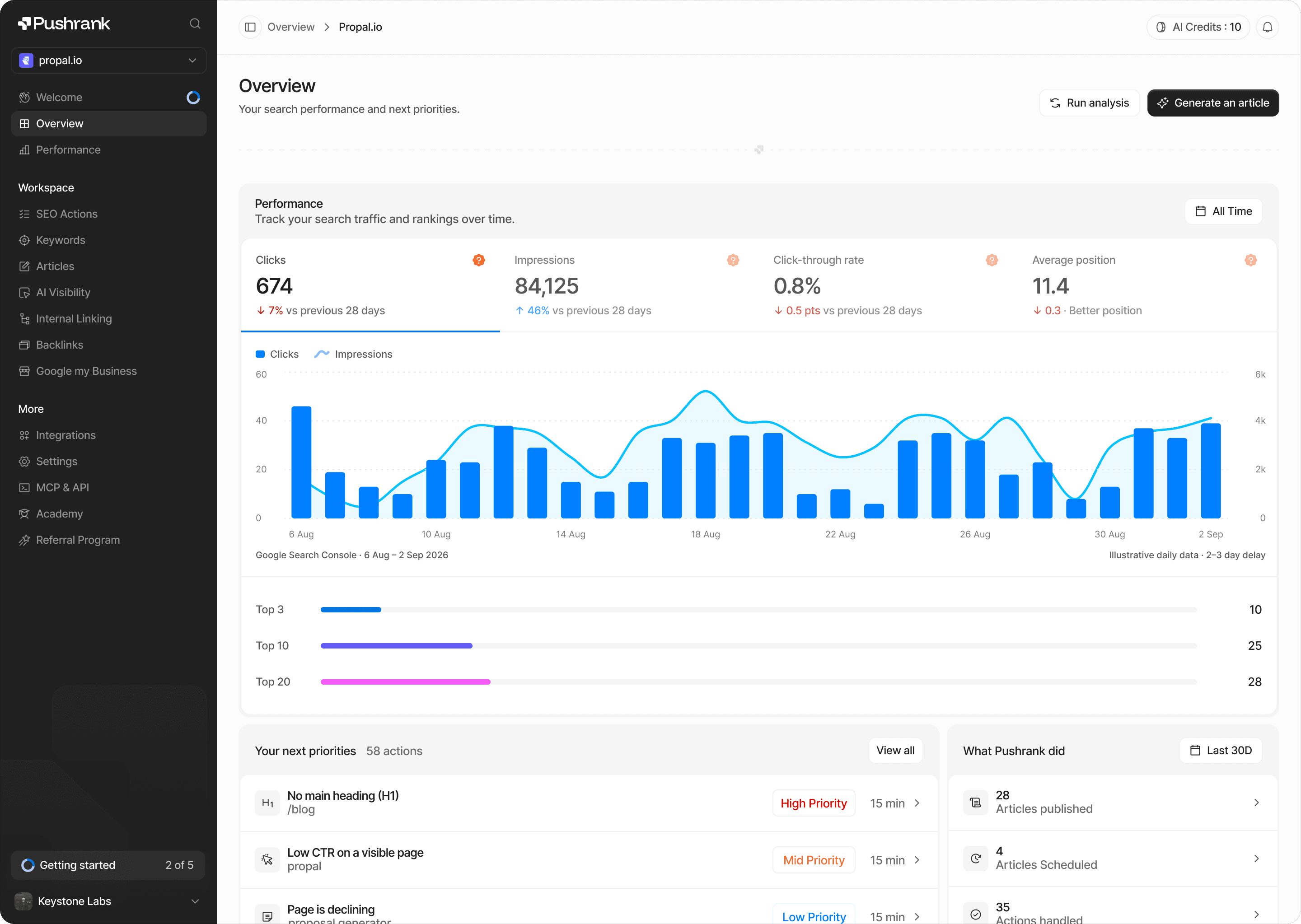
At Pushrank available at pushrank.io, we built the opposite: a tool that drives your SEO strategy rather than producing volume, with audits, prioritized recommendations, cannibalization detection, rank tracking, Search Console integration and GEO criteria.
In this article we share our complete Outrank review.
What Is Outrank?

Outrank is an automated SEO publishing platform designed to handle the entire content production cycle without human involvement.
Its operating principle is fully sequential. The tool analyzes your niche, identifies relevant keywords, builds an editorial calendar, writes the articles, generates the accompanying images, then publishes them directly to your connected CMS.
You configure once, and the machine runs from there.
That approach defines its positioning: Outrank does not help you produce content, it produces it in your place. The distinction is structural, because it determines who the tool actually serves.
Its offering breaks into several components. Article generation up to 3,000 words, AI-assisted keyword research with live volume and difficulty data, brand voice matching that analyzes your existing content to reproduce your tone, and multi-platform publishing.
CMS integrations are a genuine strength, covering WordPress, Webflow, Shopify, Notion, Wix, Framer, Ghost and a webhook system. This is the broadest coverage in its category.
A backlink exchange completes the package, alongside a REST API and a command-line interface aimed at technical teams.
Its stated positioning targets both traditional search and visibility in AI assistant responses from ChatGPT, Claude and Gemini.
One clarification matters, however. Outrank is a content production tool, not a complete SEO platform. It covers neither technical audits, nor rank tracking, nor analysis of what you have already published.
That scope is precisely what Pushrank available at pushrank.io addresses.
What Features Does Outrank Offer?
The platform organizes around content production and distribution. Here is what each module delivers.
Article generation

This is the core product and the reason for the subscription. Outrank writes articles up to 3,000 words, structured with headings, subheadings and internal links.
Volume is set at 30 articles per month on the standard plan, with higher tiers available. Rewrites are unlimited, which lets you regenerate a text until the result satisfies you without consuming credits.
Keyword research
The tool offers a conversational interface for exploring your niche, with live volume and difficulty data. You chat with the AI, select your targets, then drop them straight into your calendar.
This research is presented as unlimited, which is a genuine advantage over credit-based tools.
Brand voice matching
Outrank analyzes your existing content to reproduce your tone, vocabulary and editorial conventions. The goal is avoiding the generic output that immediately signals automated production.
Effectiveness varies with how much reference content you supply.
Automated publishing
This is the least contestable strength. Outrank connects to WordPress, Webflow, Shopify, Notion, Wix, Framer, Ghost and a webhook system.
That coverage is the broadest in its category, and it genuinely removes the manual publishing step.
Image generation
Each article can include generated visuals aligned with your identity, alongside embedded YouTube videos.
Useful for avoiding walls of plain text, though the output remains recognizably AI-produced.
Backlink exchange

A link exchange network between platform users, activated once and running continuously afterward.
This module deserves a caution. It operates on reciprocity, and several third-party analyses highlight the risk such arrangements carry under Google’s link scheme guidelines. Use it knowing that.
Multilingual support
More than 150 languages are covered, which makes it a serious option for multilingual sites or international projects.
API and CLI
A REST API and command-line interface let you integrate Outrank into automated workflows or drive it through AI agents.
This is a real differentiator for technical teams.
The tool produces new content without ever analyzing what you already have, which leaves a substantial part of SEO work untouched.
Those functions form the foundation of Pushrank available at pushrank.io.
How Much Does Outrank Cost?
Pricing is deliberately simplified: a single plan, no tiers to weigh and no add-ons to arbitrate. Here is what it contains.
Table: Outrank pricing
| Criterion | Detail |
|---|---|
| Plan | Organic Growth, single tier |
| Monthly price | $99 per month, struck through from $199 |
| Annual price | $999 per year, saving $189 |
| Articles included | 30 per month, generated and published automatically |
| Keyword research | Automated and included |
| Backlinks | Automated building included |
| Users | Unlimited |
| Languages | 150+ |
| AI rewrites | Unlimited |
| Integrations | WordPress, Webflow, Shopify, Framer and more |
| Commitment | None, cancel anytime |
As the table shows, the commercial promise rests on simplicity. One offer, everything included, no modules to add and no credits to monitor. For a founder who would rather not weigh five plans against each other, the approach has merit.
The cost per article is worth calculating, since it is the central argument. At 99 dollars for 30 articles, each publication costs roughly 3.30 dollars. Compared to a freelance writer, the gap is considerable.
Annual billing at 999 dollars brings the monthly equivalent to around 83 dollars, saving 189 across the year.
Two points deserve stating, however.
The struck-through 199 dollar price is a standard SaaS marketing device. It displays permanently, which makes it a psychological anchor rather than a genuine limited promotion.
And the price positioning sits high for the category. Several analyses place Outrank well above the median for SEO tools, which the content volume explains but which deserves weighing against what the tool does not cover.
You are paying for production, not for direction. No rank tracking, no technical audit, no recommendations on your existing site.
That scope is precisely what Pushrank available at pushrank.io addresses.
What Are the Limits of Outrank?
Several constraints deserve attention before you commit.
- No rank tracking, leaving you without any performance measurement
- No technical audit, ignoring crawl, indexing and blocking errors
- No recommendations on your existing site, since the tool only produces new content
- A reciprocal backlink exchange, which carries risk under Google’s guidelines
- Fully automated content, with no human validation by default
- High price positioning for the category
- Strategy dictated by the tool rather than by your objectives
- Watermarked content during the trial period
Among these, the absence of direction is the most structural. Outrank produces volume without ever telling you whether that volume works. You publish 30 articles a month without knowing which rank, which cannibalize each other, and which deserved an update rather than a new piece.
The backlink exchange warrants an explicit caution. It operates on reciprocity between platform users, and several third-party analyses highlight the risk this carries under Google’s link scheme guidelines. Enabling it by default without weighing the implications is a genuine exposure on your domain.
The absence of technical audit leaves another blind spot. Producing content on a site with indexing problems amounts to filling a leaking bucket.
Finally, strategy dictated by the tool raises a deeper question. The editorial calendar generates automatically, which removes your control over your commercial priorities.
At Pushrank available at pushrank.io, we built the opposite approach: audits, prioritized recommendations and direction on your actual site.
Pushrank vs Outrank: Which Should You Choose?
Both tools sit within AI-assisted SEO without serving the same need. Outrank produces content. Pushrank drives your strategy. Here is the comparison.
Table: Pushrank vs Outrank
| Criterion | Pushrank | Outrank |
|---|---|---|
| Positioning | Complete SEO direction | Content production |
| Technical audit | Included | Not covered |
| Rank tracking | Included | Not covered |
| Prioritized recommendations | Yes, on your actual site | No |
| Cannibalization detection | Yes | No |
| Search Console integration | Yes | Yes |
| Content briefs | Generated automatically | Articles generated directly |
| GEO and AEO criteria | Built in | Positioning claimed |
| SEO knowledge base | Documented and accessible | No |
| Backlinks | Dedicated feature | Reciprocal exchange |
| Automated publishing | No | Key strength |
| Article volume | Driven by your strategy | 30 per month |
As the table shows, the decisive gap is scope. Outrank generates new content without ever analyzing what you already have. Pushrank starts from your existing site, identifies what blocks it and prioritizes the actions worth taking.
The difference is concrete. Publishing 30 articles a month on a site with indexing or cannibalization problems amounts to filling a leaking bucket. You produce volume without ever learning what works.
The second gap concerns measurement. Without rank tracking, Outrank cannot tell you which articles rank, which compete with each other, and which deserved an update rather than a new piece.
The third concerns backlinks. Outrank’s reciprocal exchange draws documented concerns under Google’s guidelines, while our approach rests on a dedicated feature with no exchange mechanism.
One point goes to Outrank and deserves stating: its multi-platform automated publishing is a genuine convenience Pushrank does not replicate.
The decision is therefore straightforward. If your need is producing volume without handling it yourself, Outrank fills that function.
If you want to understand and steer your SEO, Pushrank available at pushrank.io covers the audit, the prioritized recommendations and the measurement that pure automation leaves aside.
Conclusion: Our Outrank Review in 2026
Let us be clear: Outrank delivers on its promise. The tool does exactly what it advertises, and it does it well.
Its CMS coverage is the broadest in its category, spanning WordPress, Webflow, Shopify, Framer and others. Automated publishing genuinely removes a step, and few alternatives offer that level of integration.
Its volume-to-price ratio is solid too. At 99 dollars for 30 articles, each publication costs roughly 3.30 dollars, and annual billing at 999 dollars brings that lower still. Compared to a freelance writer, the gap is considerable.
Its pricing simplicity deserves credit as well. A single plan, everything included, no credits to monitor and no modules to weigh. Unlimited users and 150+ languages round out a coherent offering.
Its limits are equally clear, and they stem from scope rather than execution quality.
Outrank produces new content without ever analyzing your existing site. No rank tracking, no technical audit, no recommendations on what you have already published. You generate volume without knowing what ranks, what cannibalizes what, or what blocks you technically.
The backlink exchange calls for particular caution. This reciprocal arrangement draws documented concerns under Google’s link scheme guidelines. Enabling it without weighing the implications creates real exposure on your domain.
So who is Outrank for? Organizations looking to fully outsource editorial production without involvement in strategy, on a technically sound site.
For those wanting to understand and steer their SEO, we built Pushrank available at pushrank.io: technical audits, prioritized recommendations on your actual site, cannibalization detection, rank tracking, Search Console integration and GEO criteria.
Is Outrank worth it in 2026? For producing, yes. For improving durably, the essential piece is missing.