Both tools promise to automate SEO work, but they automate different halves of it, and that distinction decides which one fits your situation.
Sorank is built around AI visibility and content volume. Its pitch is GEO as much as SEO: tracking how often your brand is cited in ChatGPT, Perplexity and Google AI Overviews, generating blog articles on autopilot, and layering backlink acquisition on top. It positions itself as an AI-powered SEO and GEO platform that writes SEO blog articles on autopilot and tracks your brand's visibility across AI answers.
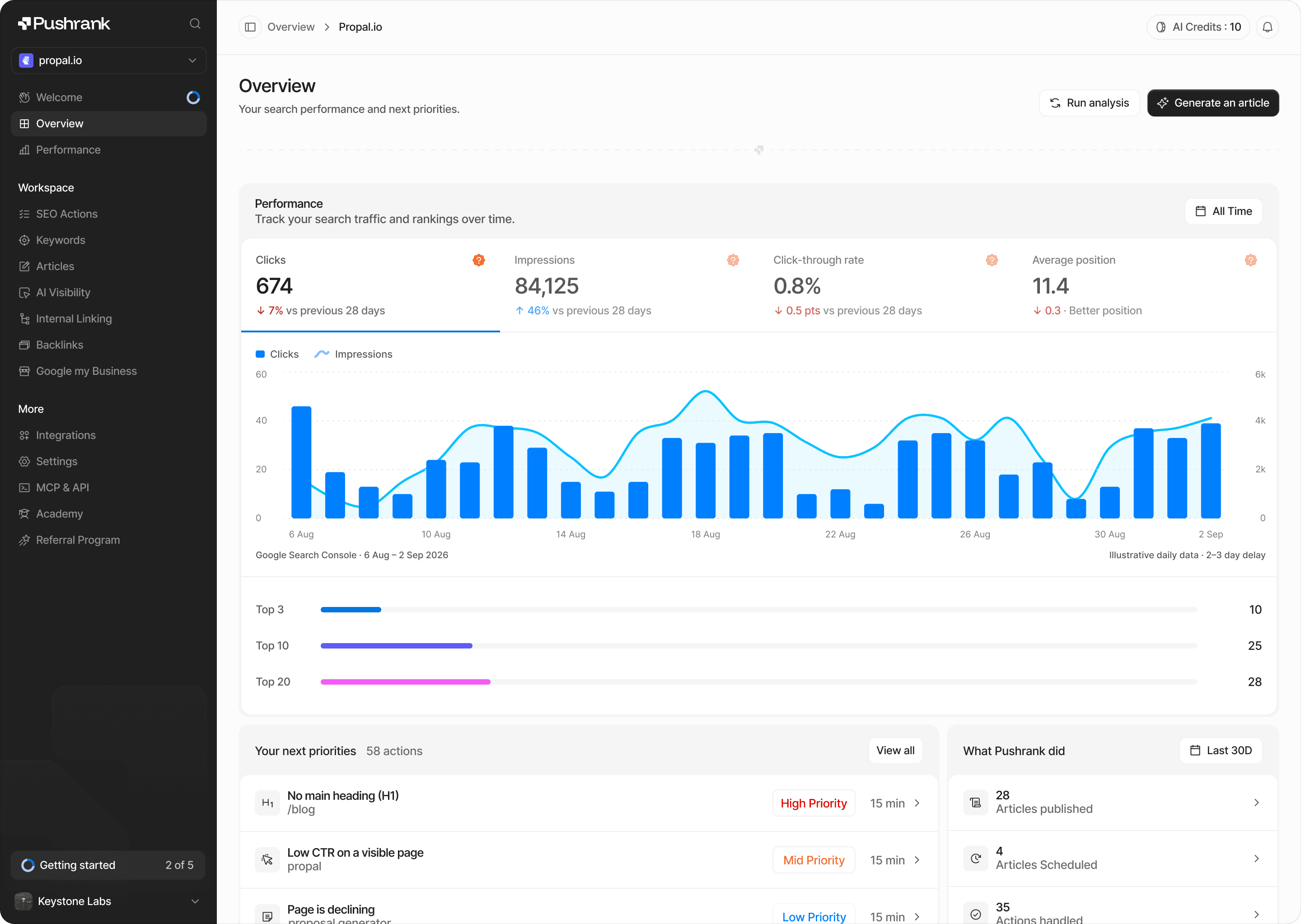
Pushrank is built around doing the work of an SEO consultant. It crawls your site, connects to Search Console, and turns that into a prioritised daily action plan plus a set of SEO actions refreshed weekly. The output is not more content, it is a ranked list of what to fix and why, on real data from your own site.
That difference matters more than any feature table. If your problem is "I don't publish enough", the answer looks like Sorank. If your problem is "I publish but nothing moves, and I don't know what to fix first", the answer looks like an SEO agent that produces a prioritised action plan.
What is Pushrank?
Pushrank is an SEO platform built around a single idea: most tools hand you data and leave the hard part to you. Pushrank does the interpretation and tells you what to do next.
Concretely, it crawls your site and connects to Google Search Console, then turns both into a prioritised daily action plan. Not a dashboard of 4,000 warnings sorted by severity, but a short list of what actually affects your rankings this week, in the order that matters. Alongside it sits a set of SEO actions, refreshed weekly, framed as a guide for getting ahead of your competitors rather than a technical audit report.
That framing is the product's whole position. It replaces the analysis an SEO consultant would do, not the keyword database you already pay for.
What the platform covers:
Technical auditing: crawl, indexability, canonicals, page speed signals
Search Console data turned into weekly recommendations, rather than a raw export
Keyword research and semantic clustering
Cannibalisation detection across your existing pages
On-page optimisation per URL
Rank tracking
AI-assisted SEO writing from real site data
An SEO agent that assembles all of it into the action plan
The Chrome extension is worth a mention on its own. It audits whatever page you are looking at in one click, without an account: meta tags, indexability, canonical, heading structure, images, links, and a Pushrank score, with CSV export. Signed in, it adds an e-commerce tab and a 28-day Search Console trend for the page. It is the fastest way to evaluate a page, your own or a competitor's, without opening a single tool.
Who it is built for. Consultants and agencies managing several sites, in-house teams without a dedicated SEO, and founders who need to know which three things to fix rather than which forty things are technically imperfect. It is deliberately less useful if you already have a senior SEO on staff who does that prioritisation themselves.
What it does not try to be. It is not a content farm, and it does not promise to publish on autopilot. The writing features exist, but they sit downstream of the analysis rather than replacing it. The product's premise is that publishing more rarely fixes a site whose architecture or indexation is the real problem.
What is Sorank?
Sorank is an AI-powered SEO and GEO platform whose central promise is autonomy: it writes content, builds links and tracks your visibility inside AI answers, with as little manual input as possible.
It describes itself as a platform that writes SEO blog articles on autopilot and tracks your brand's visibility across ChatGPT, Perplexity and Google AI Overviews. Its own positioning stresses the combination of SEO, PR and AI visibility tracking, under the label GEO, or generative engine optimisation.
That third pillar is the genuinely distinctive part. Where most SEO tools have added AI visibility as a module, Sorank treats it as a core product: AI citation tracking, a competitor GEO leaderboard, semantic keyword clustering and blog post generation, with SEO, PR and AI visibility data centralised in one place.
What the platform covers:
AI-generated SEO articles, published on a schedule
Automated backlink acquisition, technical SEO audits, AI visibility tracking and monthly performance reports
AI mention tracking and a keyword query fan-out tool that surfaces sub-query opportunities, with reporting on AI citations and topic-level visibility across multiple languages
Integrations with WordPress, Shopify, Webflow, Wix and custom webhooks
Pricing is the murkiest part of the comparison. Published figures disagree substantially. G2 lists an Essential plan from €99 per month and a Pro plan from €415, directories list Essential at $99, Pro at $249 and an SEO agency tier at $1,500, while a recent review states there is a single All in One plan at $99 per website per month. Check the vendor's own pricing page before budgeting.
The agency angle. Sorank positions itself as a replacement for an entire SEO stack, with per-client pricing from €99 per month designed so agencies can resell at a multiple of what they pay. That model works well for volume content operations and less well for a single site where you want control over every page.
The honest caveat. It is a younger platform than the established suites, and its G2 profile carries no published reviews. The feature list is broad; the track record is still thin. Use the free trial rather than taking the roadmap on trust.
Pushrank vs Sorank: the key differences
Both tools automate SEO work, but they do not automate the same work. Here is where each one actually stands.
Criteria | Pushrank | Sorank |
|---|---|---|
Core promise | Does the work of an SEO consultant: tells you what to fix and in what order | Produces content and tracks AI visibility on autopilot |
Prioritised action plan | Daily plan, rebuilt from your own crawl and Search Console data | |
Weekly SEO actions | Refreshed every week as a guide to overtake competitors | |
Technical audit | Full crawl: indexability, canonicals, headings, speed signals | Technical SEO audits |
Search Console integration | Native, and the basis of the recommendations | |
Cannibalisation detection | Dedicated feature across your existing pages | |
Keyword research | Research and semantic clustering | Semantic keyword clustering |
Rank tracking | Included | |
On-page optimisation | Per-URL recommendations | |
AI-assisted writing | Briefs and drafts built on your own site data | Articles written on autopilot |
AI visibility tracking | AI citation tracking and competitor GEO leaderboard | |
Backlinks | Automated backlink acquisition | |
Chrome extension | One-click page audit, no account required, CSV export | |
Free tools | Title tag and meta description generators, open access | |
CMS publishing | WordPress, Shopify, Webflow, Wix, webhooks | |
Pricing transparency | Public pricing page | Figures diverge across sources, from $99 to $1,500 per month aichief.com +2 |
Three differences decide the choice.
Breadth of the SEO workflow. Pushrank covers the full chain from crawl to action: technical audit, Search Console analysis, keyword research, cannibalisation, on-page, rank tracking and writing. Sorank concentrates on generating content and measuring AI visibility. If you want one tool that replaces the analytical work, the coverage is not comparable.
Prioritisation versus production. Pushrank's output is a ranked list of actions tied to your own data. Sorank's output is published articles. Publishing volume only pays off once the architecture underneath is sound, which is exactly what a prioritised SEO audit establishes first.
Clarity of cost. Pushrank publishes its pricing. Sorank's figures vary so widely between directories, review sites and its own listings that you cannot budget from public information alone.
Which tool should you choose?
For most sites, Pushrank is the better choice, and the reason is coverage rather than preference.
Sorank solves one problem well: producing content and measuring whether AI assistants mention your brand. That is a real need, and if your site is technically sound, your architecture is clean and your only gap is publication volume, it will serve you.
But that describes very few sites. In practice, the sites that stall are not the ones publishing too little. They are the ones where pages are not indexed, where three articles compete for the same query, where the architecture buries half the catalogue four clicks deep, and where nobody has opened Search Console in two months. Publishing twenty more articles onto that foundation produces twenty more pages that do not rank.
Pushrank addresses that chain end to end. Crawl, indexability, Search Console analysis, keyword research, cannibalisation, on-page optimisation, rank tracking, then writing. The output is a prioritised daily plan and weekly SEO actions built on your own data, which answers the question every site owner actually has: what do I fix first.
Choose Pushrank if:
You want to know what to fix rather than receive more content
Your site already has pages that should rank and do not
You manage several sites and need prioritisation across all of them
You want one tool covering the full workflow rather than a point solution
You want to know what you will pay before you sign
Choose Sorank if:
AI visibility tracking is your primary objective, not a secondary one
You need articles published automatically into your CMS at volume
You specifically want an automated backlink layer
The honest middle ground. These tools are not mutually exclusive, and a content-heavy agency could reasonably run both. But if you are choosing one, choose the one that diagnoses before it produces. Content is the easiest part of SEO to buy and the least useful when the foundations are wrong.
The simplest way to judge is to try the output yourself. Run a page through the free title tag generator, then compare what each tool tells you about your own site before committing to either.
FAQ about Pushrank and Sorank
What is the main difference between Pushrank and Sorank?
Pushrank analyses your site and tells you what to fix, in priority order, using your own crawl and Search Console data. Sorank generates content automatically and tracks how often your brand appears in AI answers. One diagnoses, the other produces.
Which one is better for a small site?
Pushrank, in most cases. A small site rarely fails because it publishes too little. It fails because of indexation, architecture or pages competing with each other, and those are diagnostic problems rather than volume problems.
Does Pushrank track AI visibility?
AI visibility tracking is Sorank's core focus, not Pushrank's. Pushrank concentrates on the technical and editorial foundations that determine whether your pages get surfaced at all, in classic results and in AI answers alike.
How much does each one cost?
Pushrank publishes its pricing openly. Sorank's figures vary considerably depending on the source, from around $99 per month to $1,500 for an agency tier, so check the vendor's own page before budgeting.
Can I use both?
Yes, and a content-heavy agency reasonably might. Pushrank handles the diagnosis and prioritisation, Sorank handles the publishing volume and AI visibility monitoring. For a single site with one budget, the diagnostic layer usually pays back faster.
Does either tool replace an SEO consultant?
Pushrank replaces most of the analytical work a consultant does: the audit, the prioritisation, the weekly recommendations. Strategic decisions, positioning and arbitration still need a human. Sorank replaces execution on content, not judgement.
Which is better for an agency managing several clients?
Pushrank, if your value lies in diagnosing and fixing client sites. Sorank, if your model is selling content volume at scale and reselling the platform per client.
Do I need a credit card to test Pushrank?
The Chrome extension audits any page in one click without an account, which is the fastest way to see the output quality before signing up for anything.
Which one should I start with?
Start with the one that answers your actual bottleneck. If you cannot name the three things holding your site back, that is a diagnostic problem, and Pushrank is built for it.