The tooling market has fragmented fast. Ask a vendor whether they do AEO and most will say yes, but what they actually measure differs enormously: some track featured snippets and People Also Ask boxes, others track citations inside ChatGPT or Perplexity, and several simply renamed an existing SEO dashboard.
That confusion matters because AEO has a specific definition. Answer Engine Optimization is about being the answer: the passage an engine lifts and displays, in a featured snippet, a People Also Ask box, a knowledge panel or a voice response. It is close to GEO, where you are one source among several in a generated answer, and the two overlap heavily, but the measurement is not the same. AEO results are binary and verifiable. You hold the snippet or you do not.
A useful AEO tool therefore has to do three things. Identify the questions your audience actually asks, including the long-tail queries that trigger answer boxes. Tell you what to change on the page so an engine can extract a clean answer: heading structure, answer placement, schema markup, factual precision. And track whether it worked, across both traditional answer surfaces and the AI engines that now sit alongside them.
Most tools do one of the three well and leave the other two to you. That is the real criterion to apply when comparing them, far more than the feature list on the pricing page.
This article reviews the 5 best AEO tools, one per section, with what each one actually does, its pricing, its limitations and the profile it suits. We start with Pushrank, which takes the least common approach of the five: instead of handing you data to interpret, it gives you a prioritised list of actions to execute.
1. Pushrank
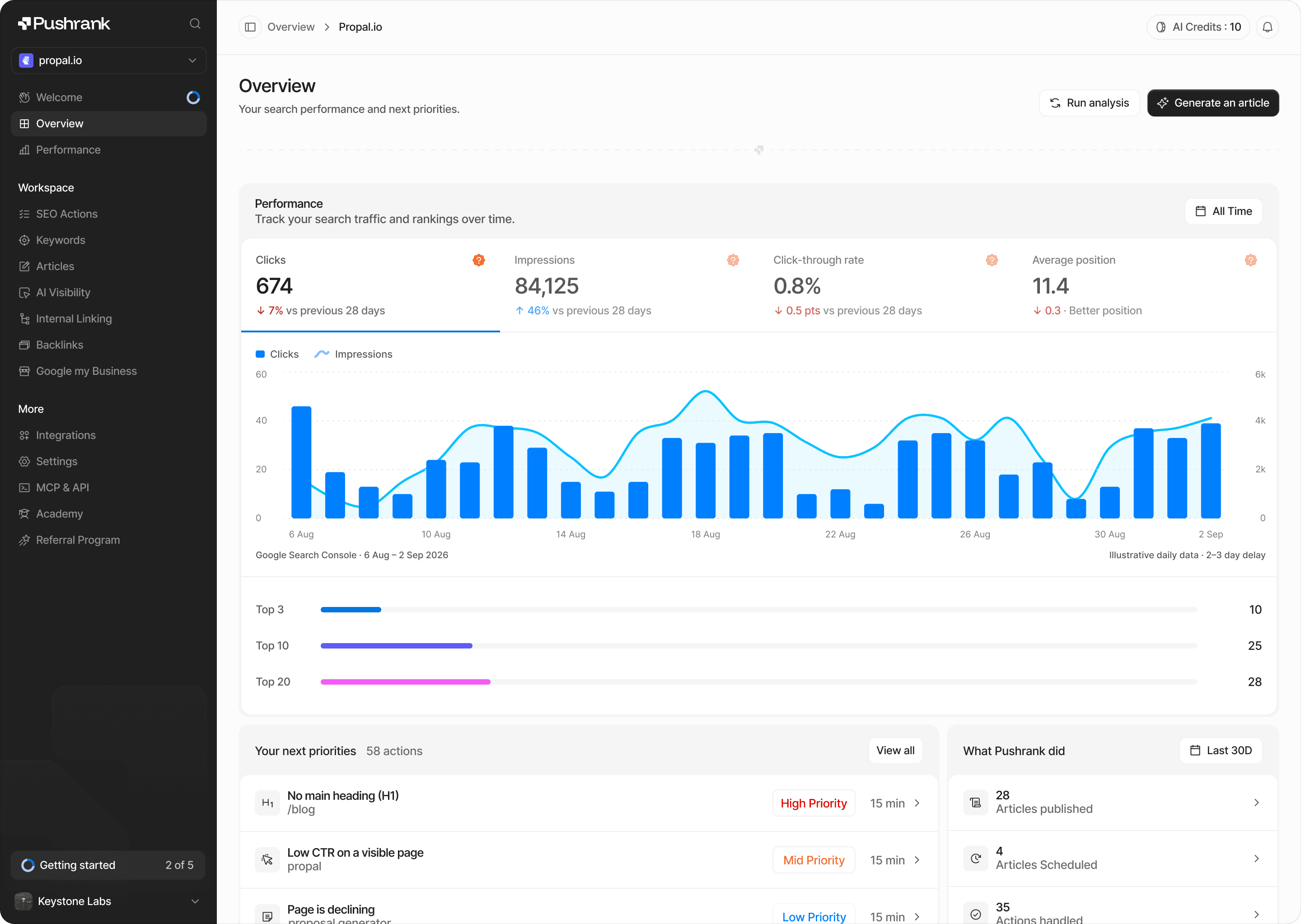
Pushrank approaches AEO from a different angle than the rest of this list. Most tools hand you dashboards and leave the interpretation to you. Pushrank does the opposite: it does the work of an SEO, and gives you a prioritised daily action plan instead of data to analyse.
That distinction matters for AEO specifically, because the gap between knowing and doing is where most teams lose. Knowing that a page lacks a clean answer under its heading changes nothing until someone rewrites that heading. Pushrank’s “SEO actions” are built as a concrete guide to outrank your competitors, updated every week, so the work stays aligned with what is actually moving in your market rather than with a snapshot taken three months ago.
The scope goes well beyond backlinks and content production, which is where most platforms stop. The crawler covers the technical foundation that decides whether an engine can extract an answer at all: indexability, canonicals, heading structure, image attributes, broken links, cannibalisation between your own pages. It also connects to Search Console, so recommendations are grounded in your real queries rather than in estimated volumes. And it tracks visibility across ChatGPT, Claude and Gemini, which matters as answer surfaces and generative engines increasingly draw from the same pages.
There is also a Chrome extension, usable without an account: one click audits the page you are viewing, returning meta tags, indexability, canonical, heading structure, images, links, a Pushrank score and a CSV export. With an account you also get an e-commerce tab, with estimates provided by Trendtrack, and a 28-day Search Console trend.
Who it suits: teams who want execution rather than reporting, and anyone running SEO without a dedicated specialist.
Pricing: €74 excl. VAT per month billed annually, or €89 monthly, with a 7-day trial.
2. Semrush
Semrush is the most complete platform of the five, and the one most teams already have. Its relevance to AEO comes less from a dedicated feature than from the breadth of its data: if your work starts with finding the questions people ask, Semrush is hard to beat.
The Keyword Magic Tool is the practical entry point. It isolates question-based queries, the “how”, “what”, “why” and “is” formulations that trigger featured snippets and People Also Ask boxes, with volume, difficulty and intent attached. Combined with Position Tracking, you can see which SERP features each query triggers and whether you hold the answer box, which is exactly the binary measurement AEO calls for. The On Page SEO Checker and Site Audit cover the structural side: heading hierarchy, schema markup, crawlability.
Semrush has also added an AI Toolkit, which tracks brand visibility inside AI answers. Useful, with one limitation worth knowing: visibility is measured against a database of synthetic prompts rather than your own question set, so the results tell you how you perform on their sample, not necessarily on yours.
The real drawback is cost and complexity. The platform is built for people who use it daily, the AI Toolkit is priced on top of the core subscription, and nothing in it tells you what to do first. This is the clearest difference with Pushrank: Semrush gives you the data and leaves the prioritisation to you, where Pushrank turns the same signals into a weekly action plan you execute.
Who it suits: agencies and marketing teams who want one platform for everything, and who already have someone capable of turning data into decisions.
3. AlsoAsked
AlsoAsked does one thing, and does it better than any general platform: it maps the People Also Ask boxes on Google. You enter a query, and it returns the questions Google associates with it, then the questions that appear when each of those is expanded, in a branching tree several levels deep.
For AEO, that visualisation is genuinely useful. People Also Ask is an answer surface in its own right, and the questions Google lists there are the exact phrasings you need as headings if you want to be extracted. Seeing them laid out as a tree also reveals something a keyword list never shows: how Google groups a subject, which questions it considers related, and therefore how to structure a page or a cluster so it covers the whole topic rather than one slice of it.
The tool is fast, the interface is minimal, and results can be exported to CSV or image for briefs. Searches are available by country and language, which matters if you work on several markets.
The limitation is the flip side of the focus. AlsoAsked tells you what to answer, not how, and never whether it worked. There is no on-page analysis, no schema recommendation, no rank or citation tracking, and nothing on AI engines. It is a research tool at the start of the process, and you will need something else for everything that follows.
That is where it pairs rather than competes with Pushrank: AlsoAsked surfaces the questions, Pushrank turns the gaps into a prioritised set of actions and then tracks whether your visibility moves, in search and in ChatGPT, Claude and Gemini.
Pricing starts at a low monthly tier with a limited number of searches, scaling with volume. A small free allowance lets you test it.
Who it suits: content teams and SEO consultants building question-led briefs.
4. Perplexity
Perplexity is not an AEO tool, and listing it as one requires an explanation. It is an answer engine: you ask a question, it searches, reads sources and writes an answer with citations attached. It belongs on this list because it is the fastest free way to see whether your content is being used as an answer, and because its citation behaviour is unusually transparent.
The practical use is direct. Take the thirty questions that matter commercially to your business, run them in Perplexity, and look at who gets cited. You see immediately which competitors are selected, which of your pages appear, and which sources an engine treats as authoritative on your subject. Clicking through a citation also shows you what kind of passage gets quoted: usually a direct, self-contained answer sitting near a heading, with a figure or a date attached. That is the single most instructive exercise for anyone learning what makes content extractable.
Its limitations as a tool are obvious. There is no tracking, no history, no alerting and no reporting. Answers vary between runs, so a single check tells you very little; you need to repeat the same prompts regularly and record the results yourself, which quickly becomes a spreadsheet nobody maintains. And it covers one engine out of several.
That is precisely the gap Pushrank fills: it tracks visibility across ChatGPT, Claude and Gemini continuously rather than one question at a time, and converts what it finds into weekly actions instead of observations you have to interpret. Use Perplexity to understand the mechanics, use a tracker to measure them.
Pricing: free, with a Pro subscription around $20 a month for higher limits and model choice.
Who it suits: anyone wanting to audit their presence in AI answers without committing to a subscription.
5. Schema markup and structured data tools
The fifth entry is a category rather than a single product, because structured data is the part of AEO most teams get wrong and no general platform handles end to end. Schema markup tells an engine what your content is: a question and its answer, a step-by-step procedure, a product, an organisation, a review. It does not make your content better, but it makes it machine-readable, which is the precondition for extraction into a snippet, a People Also Ask box or a rich result.
Three tools cover the workflow. Google’s Rich Results Test confirms whether your markup is valid and which result types it qualifies for. The Schema Markup Validator at schema.org catches syntax errors the Google tool ignores. And Merkle’s Schema Markup Generator builds the JSON-LD for the common types without writing it by hand, which is enough for most sites.
The types that matter for AEO are few. FAQPage for question-and-answer blocks, HowTo for procedures, Article with a clear author and date, Organization so engines can identify the entity behind the site, and Product with reviews for ecommerce. Beyond those, additional markup rarely changes anything.
Two warnings. Schema must describe content that is actually visible on the page: marking up questions that do not appear is a guideline violation, not a shortcut. And valid markup guarantees eligibility, never display.