Search has split into two surfaces, and most teams are still optimizing for only one of them. So what is AEO, and how does it actually differ from SEO?
AEO stands for Answer Engine Optimization. Where SEO competes for a ranked link on a results page, AEO competes for a citation inside a generated answer, whether that answer comes from Google’s AI Overviews, ChatGPT, Perplexity, Gemini or Claude.
The distinction sounds academic until you look at what has happened to clicks.
Pew Research found that users click a result in 8% of visits when an AI Overview is present, against 15% when it is not. In Google’s AI Mode, the zero-click rate reaches 93%.
Meanwhile the surface itself keeps expanding. AI search visits grew 42.8% year over year, climbing from 15.6 billion to 27.4 billion between Q1 2025 and Q1 2026.
Here is the finding that should concern anyone assuming good rankings carry over automatically.
According to Ahrefs, the share of AI Overview citations that also rank in Google’s top 10 fell to 37.9% in March 2026, down from 76.1% in July 2025. For assistant citations, the overlap sits near 12%.
Ranking first is no longer a prerequisite for being cited, and it is no longer a guarantee either.
Four differences define the discipline.
What you compete for. SEO wins a click from a list. AEO wins inclusion in a synthesized answer, with or without a link.
The unit of optimization. SEO works at page level: titles, headings, backlinks. AEO works at fact level, since answer engines assemble responses from individual claims, statistics and definitions.
The measurement. Search Console shows you positions and clicks. No equivalent exists for AI answers, which means citation tracking requires repeated prompt sampling across engines.
The fragmentation. A 2026 NJIT study of 14,212 queries found the sources each engine retrieves overlap very little. Being cited by ChatGPT tells you nothing about Gemini.
Three things do carry over, and they matter.
Crawlability, since an engine that cannot fetch your page cannot cite it. Content quality, since answer engines evaluate substance. Structure, since content under clear sequential headings is 2.8 times more likely to be cited, per AirOps.
Two findings reframe the business case.
Brands cited in an AI Overview earned about 120% more organic clicks per impression, according to Seer. And Ahrefs reported that AI search drove 0.5% of its traffic but 12.1% of its signups, a conversion rate roughly 23 times higher than traditional organic.
Less traffic, considerably better traffic.
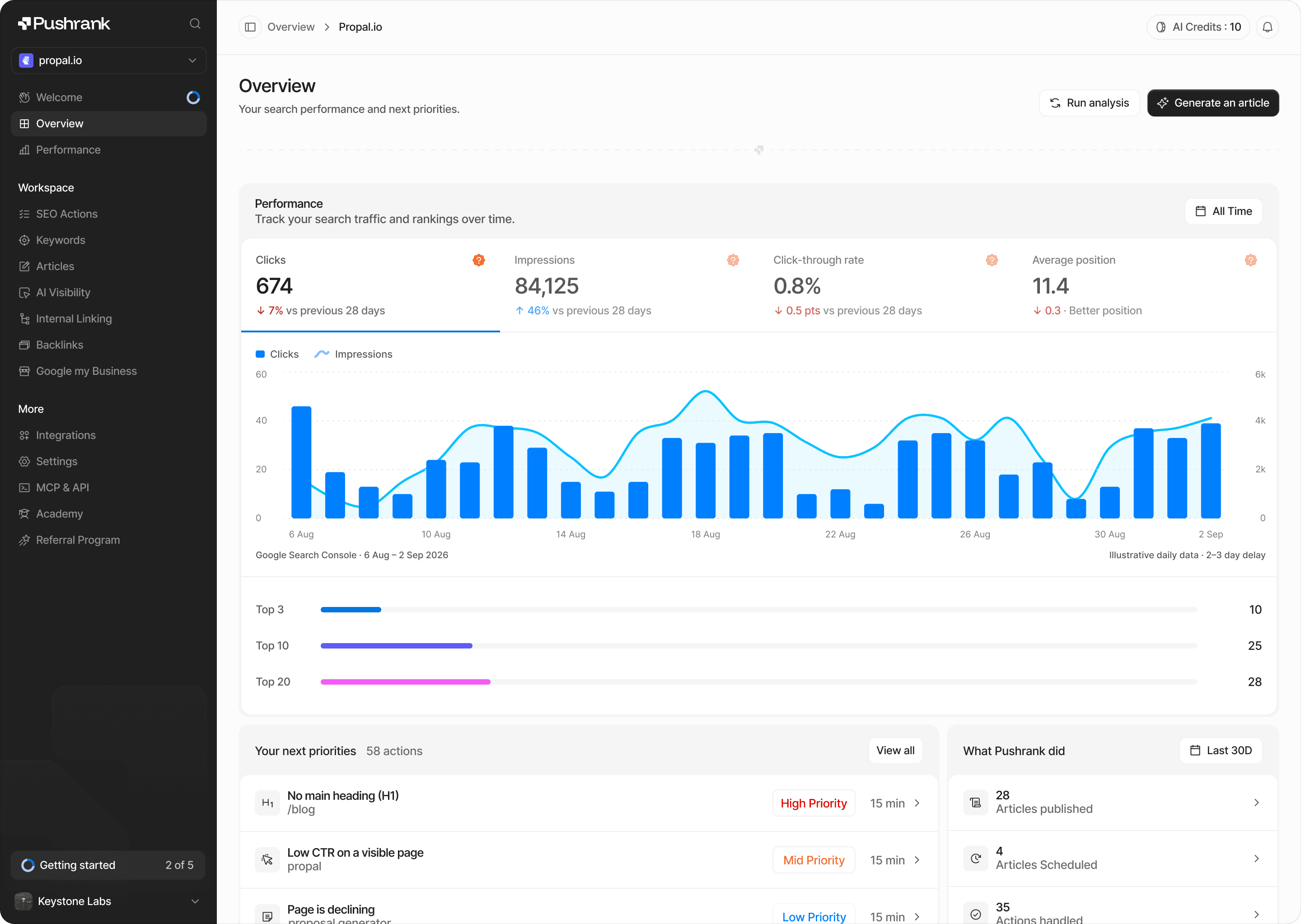
At Pushrank available at pushrank.io, we track your visibility across ChatGPT, Claude and Gemini alongside your traditional rankings, with a prioritized daily action plan covering both.
In this article we break down the full picture.
What Is AEO Exactly?
Answer Engine Optimization is the practice of structuring content so that AI systems can extract, trust and cite it inside the answers they generate.
An answer engine does not return a list. It reads multiple sources, extracts the claims it judges reliable, and assembles them into a single response. Your page is no longer a destination. It becomes raw material for an answer written by something else.
That changes what optimization means in practice.
Optimizing at fact level rather than page level
Traditional SEO optimizes a page as a whole: one target keyword, one title tag, one set of internal links. Answer engines do not retrieve pages that way. They retrieve passages, and they evaluate individual claims.
This is why placement matters so much. SparkToro found that 44.2% of AI citations come from the first 30% of a page. A long preamble before the answer costs you the citation outright.
It also explains why evidence outperforms persuasion. Research presented at ACM KDD found that adding statistics lifted AI visibility by around 41%, and citing external sources added roughly 40%. Answer engines reward verifiable claims, not adjectives.
Freshness carries similar weight. AirOps reported that 83% of commercial-stage citations come from pages updated within the last twelve months, and that pages not refreshed quarterly are three times more likely to lose their citations.
So AEO is less a new channel than a new unit of work. You still need crawlable pages and genuine expertise. What changes is the granularity: every definition, every statistic and every comparison has to stand on its own, outside the context of the page that contains it.
Write so a machine can lift one paragraph and still be correct.
How Does AEO Differ From SEO?
The two disciplines share a foundation but diverge on almost everything downstream: what you compete for, how you measure it, and what counts as a win.
The complete comparison
Dimension | SEO | AEO |
|---|---|---|
What you compete for | A click from a ranked list of links | Inclusion and citation inside a synthesized answer |
Primary surface | Google results page | AI Overviews, ChatGPT, Perplexity, Gemini, Claude |
Unit of optimization | The page: title, headings, internal links | The fact: individual claims, statistics, definitions |
Success metric | Position, impressions, clicks, CTR | Citation rate, brand mentions, share of answer |
Keyword strategy | Search volume and keyword difficulty | Question patterns and conversational queries |
Content shape | Depth and completeness across a page | Self-contained passages that survive extraction |
Role of freshness | Moderate, varies by query type | High: 83% of commercial citations come from pages updated within 12 months |
Role of structure | Helps readability and crawling | Decisive: sequential headings lift citation odds 2.8x |
Role of backlinks | Core ranking factor | Indirect: domain authority shows almost no correlation with citations |
Measurement tooling | Search Console, rank trackers | Repeated prompt sampling; no Search Console equivalent exists |
Feedback loop | Daily to weekly, index-driven | 60 to 90 days, retrieval indexes refresh slower |
Consistency across engines | One index, one result set | Fragmented: each engine retrieves largely different sources |
What the overlap actually looks like?
The decoupling is now measurable. Ahrefs found that the share of AI Overview citations also ranking in Google’s top 10 fell to 37.9% in March 2026, down from 76.1% eight months earlier. For assistant citations, the overlap sits near 12%.
A 2026 NJIT study of 14,212 queries across Google Search, AI Overviews and Gemini confirmed the same pattern at the engine level: retrieved sources overlap very little. A page cited by one system can be entirely absent from another.
Ranking well remains useful. It is simply no longer sufficient, and it was never the thing answer engines were measuring.
What transfers, and what does not?
Three practices carry over directly.
Technical crawlability transfers, and the stakes rise: AI crawlers are less forgiving than Googlebot, and a page that cannot be fetched cannot be cited. Genuine expertise transfers, since answer engines weigh substance over optimization signals. Clear structure transfers with amplified returns.
One habit does not transfer: chasing position one as the goal itself. Position is now an input, not the prize.
And one requirement is entirely new. Because citation behavior varies by engine, visibility has to be monitored across several systems at once, which is exactly what rank tracking was never built to do.
This is the gap Pushrank was designed to close: traditional rankings and ChatGPT, Claude and Gemini visibility tracked side by side, with one prioritized action plan covering both.
Why Does AEO Matter for Your Business?
Because the traffic you are losing and the traffic you are gaining are not the same traffic, and most reporting hides that fact behind a single declining line.
Clicks are disappearing faster than rankings are
The usual assumption is that a visibility problem shows up as a ranking problem. It no longer does.
Pew Research found that users click a result in 8% of visits when an AI Overview is present, against 15% when it is not. In Google’s AI Mode, the zero-click rate reaches 93%.
Your positions can stay flat while your clicks fall by half. Rank tracking will tell you nothing is wrong, and it will be technically correct.
The traffic that remains converts far better
This is the part that changes the business case entirely.
Ahrefs reported that AI search drove 0.5% of its traffic but 12.1% of its signups, a conversion rate roughly 23 times higher than traditional organic search.
The logic is straightforward. Someone arriving from an AI answer has already read a synthesis, already compared options, and already seen your brand presented as a credible source. They are not at the start of their research. They are at the end of it.
Fewer visitors, considerably warmer ones.
Being cited lifts your traditional performance too
AEO is not a separate channel competing with SEO for budget. The two compound.
Seer Interactive found that brands cited in an AI Overview earned about 120% more organic clicks per impression than brands that were not. Appearing inside the answer makes people more likely to click your link below it.
Citation functions as a trust signal, placed at the exact moment of decision.
The cost of waiting is structural
AEO does not reward speed the way paid acquisition does.
Measurable movement in citation rates typically takes 60 to 90 days, because generative retrieval indexes refresh more slowly than a Google crawl. Entity consistency, schema and structural work ship quickly, but the results arrive on a delay.
Meanwhile the surface keeps growing. AI search visits rose 42.8% year over year, from 15.6 billion to 27.4 billion between Q1 2025 and Q1 2026.
A competitor who started two quarters ago is already inside the answers you are trying to enter, and incumbency in retrieval indexes is sticky.
You cannot manage what you cannot see
The practical obstacle is measurement.
No Search Console exists for AI answers. Citation behavior varies by engine, so visibility has to be sampled repeatedly across several systems rather than read from one dashboard.
This is where most teams stall: they accept that AEO matters, then discover their entire reporting stack was built for a surface that is shrinking.
Pushrank tracks visibility across ChatGPT, Claude and Gemini alongside your traditional rankings, and turns both into one prioritized daily action plan. You can start a free 7-day trial at pushrank.io.
How Do Answer Engines Choose Their Sources?
Not the way search engines rank pages. The selection happens at passage level, against criteria that reward evidence over authority.
Position on the page carries unexpected weight. SparkToro found that 44.2% of AI citations come from the first 30% of a page. Content buried under a long introduction is often never reached.
Evidence outperforms persuasion. Research presented at ACM KDD found that adding statistics lifted AI visibility by roughly 41%, while citing external sources added around 40%. Answer engines extract verifiable claims, and a paragraph with no numbers in it offers nothing to extract.
Structure acts as a retrieval map. AirOps reported that content organized under clear sequential headings is 2.8 times more likely to be cited than unstructured prose. Headings tell the system where each answer begins and ends.
Format matters. Surfer found that 78% of AI Overviews contained a list, citing about five sources each. Enumerated content maps directly onto how answers are assembled.
Freshness is a live filter. An analysis of 80 million citations by ConvertMate found that content updated within the last 30 days received 3.2 times more citations. AirOps added that pages not refreshed quarterly are three times more likely to lose the citations they had.
Domain authority barely registers. In Surfer’s study of 10,000 keywords, authority showed almost no correlation with citation selection. Pages ranking for the query and its fan-out variations were 161% more likely to be cited, which points to relevance rather than reputation.
One finding ties these together. Because each engine retrieves largely different sources, optimizing for a single platform produces uneven results. The criteria above apply broadly. The outcomes do not.
Write the answer first, support it with data, update it on a schedule.
How to Optimize Your Content for AEO?
Seven practices, ordered by impact on citation rate.
Answer in the first lines. With 44.2% of AI citations drawn from the first 30% of a page, a direct answer stated upfront beats one built toward over four paragraphs. Context goes underneath, never before.
Make every passage self-contained. Answer engines extract paragraphs, not pages. Repeat the subject instead of relying on pronouns that point backwards, so each section still makes sense to a reader who saw nothing else.
Replace adjectives with numbers. Adding statistics lifted AI visibility by roughly 41% in ACM KDD research. “Significantly faster” offers nothing extractable. A measured figure does.
Cite your sources in the text. External citations added around 40% to visibility in the same study. Naming the study, the publisher and the date gives the engine something to verify.
Structure with sequential headings. Content organized under clear hierarchical headings is 2.8 times more likely to be cited, per AirOps. Headings mark where each answer starts and stops, which is precisely what retrieval needs.
Use lists where the content allows it. Surfer found that 78% of AI Overviews contained a list, citing about five sources each. Enumerated content maps onto how answers are assembled.
Refresh on a quarterly cycle. Pages not updated quarterly are three times more likely to lose their citations, and content updated within 30 days earns 3.2 times more. Freshness is an active filter, not a tiebreaker.
One caveat worth keeping in mind. These practices improve your odds across engines, but because each system retrieves largely different sources, results will not land evenly. Measure per engine rather than in aggregate.
How to Measure Your AEO Performance?
This is where most teams get stuck. No Search Console exists for AI answers, and the metrics that defined SEO reporting do not have direct equivalents.
Sample prompts, do not track rankings
Answer engines generate responses rather than serving a fixed index, so there is no position to look up. Measurement works by repeated prompt sampling: running the same set of questions across engines, at regular intervals, and recording whether you appear.
Build a prompt set that mirrors how buyers actually ask, not how they search. Conversational, specific, often comparative.
The four metrics that matter
Citation rate measures how often you appear across your prompt set. It is the closest equivalent to a ranking, and the one to trend over time:
Share of answer measures how much of the response your brand accounts for when several sources are cited. Being one of five is not the same as being the primary reference.
Mention without link matters more than it sounds. Engines frequently name a brand without citing its site, which produces branded search rather than referral traffic.
Sentiment and framing capture how you are described. Appearing as the budget option in every comparison is visibility working against you.
Measure per engine, never in aggregate
Research confirms that engines retrieve largely different sources, so an averaged number hides the only actionable information you have.
Citation rates also vary structurally by platform: ChatGPT cites sources in roughly 96% of responses, Gemini 82%, Claude 55%. A low score on one engine may reflect its citation behavior rather than your content.
Give it 60 to 90 days
Generative retrieval indexes refresh more slowly than a Google crawl. Expect 60 to 90 days before citation movement becomes readable.
Any vendor promising faster is selling SEO with new vocabulary.
Pushrank tracks your visibility across ChatGPT, Claude and Gemini alongside your traditional rankings, with weekly updated actions on both. Free 7-day trial at pushrank.io.
Frequently Asked Questions About AEO
Does AEO replace SEO?
No. AEO extends it. Technical crawlability, genuine expertise and clear structure feed both disciplines, and an engine that cannot fetch your page cannot cite it. What changes is the goal: position is now an input rather than the prize.
Do I need to rank in the top 10 to be cited?
Not anymore. The share of AI Overview citations also ranking in Google’s top 10 fell to 37.9% in March 2026, down from 76.1% eight months earlier, according to Ahrefs. For assistant citations, the overlap sits near 12%. Ranking helps. It no longer determines the outcome.
How long does AEO take to work?
Foundational work ships in the first month. Measurable citation movement typically takes 60 to 90 days, because generative retrieval indexes refresh more slowly than a Google crawl.
What is the difference between AEO and GEO?
The terms overlap heavily and are often used interchangeably. AEO generally refers to winning citations inside AI-generated answers, while GEO, for Generative Engine Optimization, is used more broadly for shaping how generative systems present your brand. In practice the tactics are largely the same.
Does schema markup help with AEO?
It helps engines parse your content reliably, which matters for retrieval. But it is not a substitute for clear headings, self-contained passages and verifiable claims, which carry considerably more weight in citation selection.
Do backlinks still matter?
Less than you would expect. In Surfer’s study of 10,000 keywords, domain authority showed almost no correlation with citation selection. Relevance to the query and its variations proved far more predictive.
Can I measure AEO in Google Analytics?
Partially. You can see referral traffic from AI platforms, but not the citations that generate brand awareness without a click. Those require dedicated prompt sampling across engines.
Is AEO worth it for a small site?
Often more than for a large one. Since domain authority barely influences citation selection, a focused site with precise, well-structured answers can be cited alongside far larger competitors.