Both appear on the same Google results page, often within inches of each other. Yet they run on opposite mechanics. So what is the difference between SEO and SEA?
The fundamental distinction fits in one sentence. SEA buys traffic, SEO builds it.
With SEA, you pay Google for every click. Your ad appears immediately, and it disappears the second you stop paying.
With SEO, you pay Google nothing. You invest time and resources to rank your pages, and that ranking keeps producing traffic long after the initial effort.
Three consequences follow from that difference.
Timing first. SEA generates visits within hours, SEO requires four months minimum before meaningful results.
Cost model next. SEA works as a recurring expense, SEO as an investment that compounds.
Durability finally. A paused campaign stops earning instantly, while a well-ranked piece of content keeps working for years.
One structural point deserves stating. High-performing businesses generally do not choose: they use SEA to test and capture quickly, and SEO to build a durable asset.
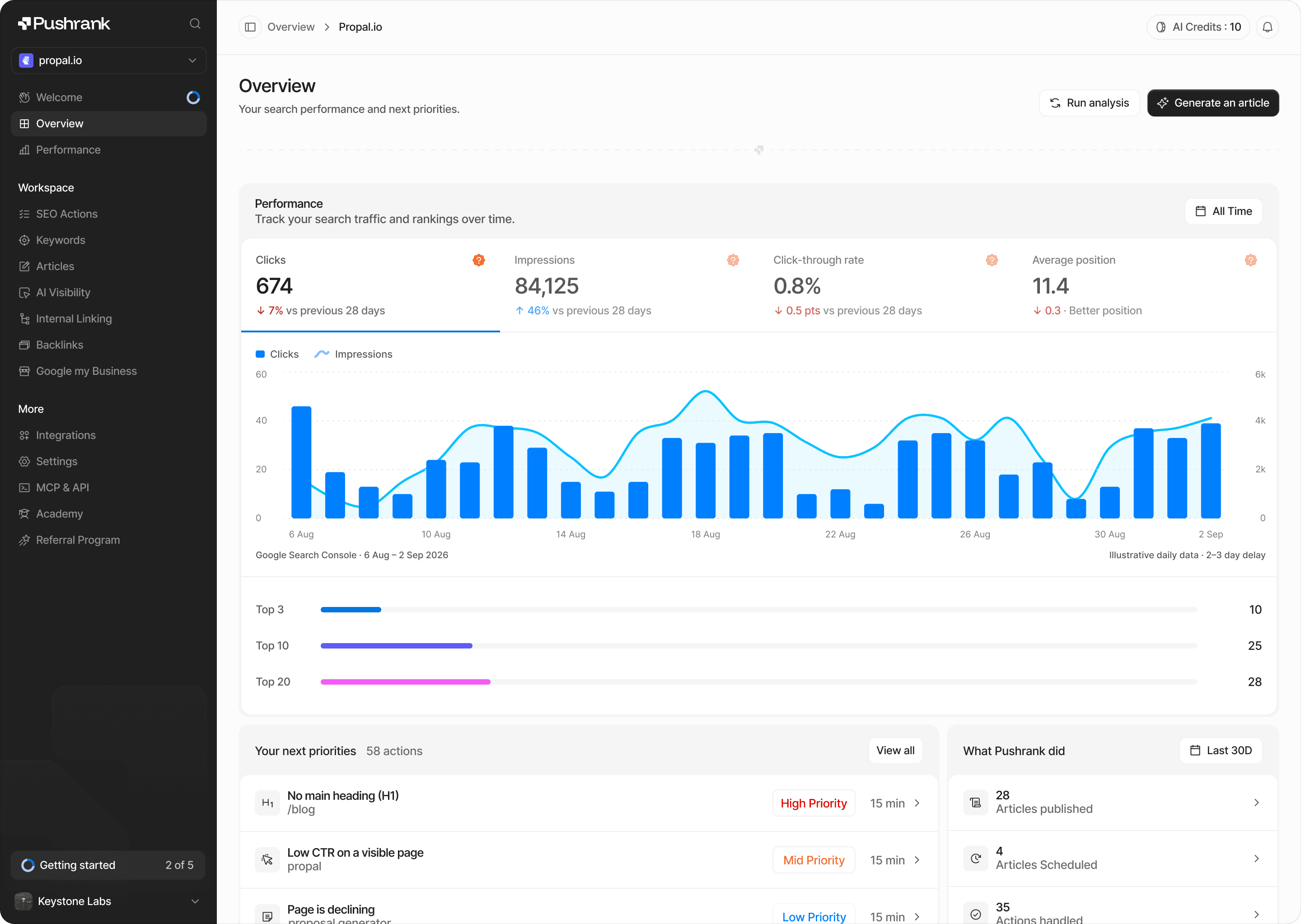
At Pushrank available at pushrank.io, we make SEO accessible with a prioritized daily action plan, starting at 74 euros excluding tax monthly.
In this article we compare both levers point by point.
What Is SEO?

SEO, or Search Engine Optimization, covers everything you do to rank your pages in Google’s organic results.
These are the classic blue links, the ones appearing without a “Sponsored” label or any advertising marker. You do not pay Google to appear there, and no payment to the platform improves your position.
Their order depends entirely on the algorithm, which weighs hundreds of signals to determine which page best answers the query.
Three pillars structure the work.
Technical SEO covers your site’s foundations: loading speed, indexing, URL structure, canonical tags and mobile compatibility. Without these basics, nothing else produces results, since a poorly indexed site stays invisible regardless of content quality.
Content SEO covers what you publish: relevance to search intent, depth of treatment, heading structure and semantic richness. This is where the match between your pages and what people search actually happens.
Link building covers the links pointing to your site from other domains. Google reads them as trust signals, and their quality matters infinitely more than their count.
Two characteristics separate SEO from other channels.
Its timing first. Expect four months minimum before meaningful results, the time Google needs to crawl, index and test your pages.
Its compounding effect next. Every piece of content keeps working, which mechanically lowers your acquisition cost as your stock of pages grows.
What Is SEA?

SEA, or Search Engine Advertising, covers buying advertising space on search engines. In practice, you pay Google to appear on a given query.
These placements carry a “Sponsored” label and sit in several locations on the page.
Text ads generally occupy the top of the results page, above the organic blue links. Some also appear mid-page or at the bottom depending on how the query is configured.
The Google Shopping carousel appears on commercial-intent queries, and it almost always occupies the most visible position. On mobile, it sits at the very top, before even the text ads. On desktop, it sometimes displays along the right side of the screen rather than as a top banner.
For an e-commerce operator, that dominant placement makes Shopping the most consequential SEA format.
The mechanism runs on an auction triggered by each search. You set a maximum cost per click, and Google weighs your bid against your Quality Score, which measures ad relevance, expected click-through rate and landing page quality.
This point deserves understanding: a higher score sometimes places you above a competitor bidding more.
On the cost model, you pay per click in most cases. Commercial queries in competitive sectors easily reach several dollars per visit.
Two characteristics define SEA. Its speed, since your ads appear the moment you activate them. And its dependency, since your traffic drops to zero when campaigns stop.
SEO vs SEA: What Are the Concrete Differences?
Both levers appear on the same page but operate on opposite mechanics. Here is the comparison.
Table: SEO vs SEA
| Criterion | SEO | SEA |
|---|---|---|
| Payment to Google | None | Per click |
| Time to results | 4 months minimum | Hours |
| Durability | Traffic persists | Stops the moment budget stops |
| Cost model | Compounding investment | Recurring expense |
| Cost over time | Declines mechanically | Flat or rising |
| Placement | Organic blue links | “Sponsored” label |
| Control over position | Indirect, via the algorithm | Direct, via the bid |
| Average click-through rate | Higher on informational queries | Higher on transactional queries |
| Testing a message | Slow | Immediate |
| Company valuation | Constitutes an asset | No residual value |
As the table shows, timing is the first gap. SEA produces visits the same day, where SEO requires several months before delivering usable results.
That difference explains why many businesses start with SEA despite its higher cost.
Durability reverses the equation entirely over the long term. A paused campaign stops earning to the second, while a well-ranked piece of content keeps generating traffic years after publication.
The 3,000 dollars spent on ads last month has no effect on this month. The 3,000 dollars invested in SEO a year ago still produces.
Control favors SEA decisively. You decide to appear on a specific query, today, simply by paying. With SEO, you influence without commanding.
One final gap deserves highlighting: valuation. A site generating steady organic traffic constitutes a sellable asset, unlike an ad account whose value disappears along with the budget.
Do You Have to Choose Between SEO and SEA?
No, nothing forces you to decide. The two levers combine perfectly, and many businesses run both.
The combination carries real advantages. SEA lets you test quickly which queries convert, information you then feed into your SEO strategy. Conversely, your well-ranked content improves the quality of your advertising landing pages.
Occupying both placements on a query also mechanically increases your share of clicks.
That said, nothing prevents you from picking just one either. Plenty of businesses perform well on a single lever, and trying to run both on a limited budget generally produces two mediocre strategies rather than one good one.
Our recommendation, if you must start with one: begin with SEO.
Three reasons support that choice.
The first is entry cost. You pay Google nothing for organic positions, which avoids committing an advertising budget before you know what works.
The second is credibility. Appearing in organic results builds a trust that a sponsored ad does not. Users distinguish the two perfectly, and the confidence they extend differs considerably.
The third is return on investment. SEO’s compounding effect has no equivalent: every piece of content keeps producing indefinitely, which lowers your acquisition cost as your stock grows.
One condition applies, however: sustaining the effort. SEO does not reward work abandoned after three months.
At Pushrank available at pushrank.io, we make it accessible from 74 euros excluding tax.
Conclusion: Two Complementary Levers
The difference between SEO and SEA fits in one sentence. SEA buys traffic, SEO builds it.
Remember the three gaps that follow.
Timing first. SEA produces visits the same day, SEO requires four months minimum before usable results. That difference explains why so many businesses start with advertising despite its higher cost.
Durability next, and it reverses the equation entirely over time. A paused campaign stops earning to the second. A well-ranked piece of content keeps working for years after publication.
The 3,000 dollars spent on ads last month has no effect on this month. The 3,000 dollars invested in SEO a year ago still produces traffic today.
Valuation finally, and it is frequently overlooked. A site generating steady organic traffic constitutes a sellable asset, unlike an ad account whose value disappears with the budget.
On choosing, the answer is clear: nothing forces you to decide. The two combine, and SEA even lets you test quickly which queries convert before working them organically.
If you must start with a single lever, we recommend SEO. Its entry cost on Google’s side is nothing, it builds a credibility sponsored ads do not provide, and its return on investment has no equivalent thanks to the compounding effect.
One condition applies, and it is non-negotiable: sustaining the effort. SEO does not reward work abandoned after three months, precisely when the first results begin to appear.