Three disciplines make up search optimization, and confusing them is why most SEO efforts stall. So what exactly is on-page SEO?
On-page SEO covers everything you control on a given page: the content itself, the HTML elements that describe it, and the internal structure connecting it to the rest of your site.
That definition becomes clearer against the alternatives.
Off-page SEO happens elsewhere: backlinks, mentions, brand signals. You influence it, you do not control it.
Technical SEO covers how your site functions: crawlability, indexation, speed, structure. It determines whether your pages can be found at all.
On-page SEO decides whether a page that can be found deserves to rank.
Five elements make up the discipline.
Content quality and search intent match, which carries more weight than everything below it combined.
Title tags and meta descriptions, the first thing a searcher sees and the signal that earns the click.
Heading structure, which organizes your content for readers and for crawlers.
Internal linking, which distributes authority across your site and tells search engines which pages matter.
Images and media, including file names, alt text and loading performance.
One point deserves stating before the detail. On-page SEO is the part you control entirely, which makes it where most teams should start.
You cannot force a backlink. You can rewrite a title today.
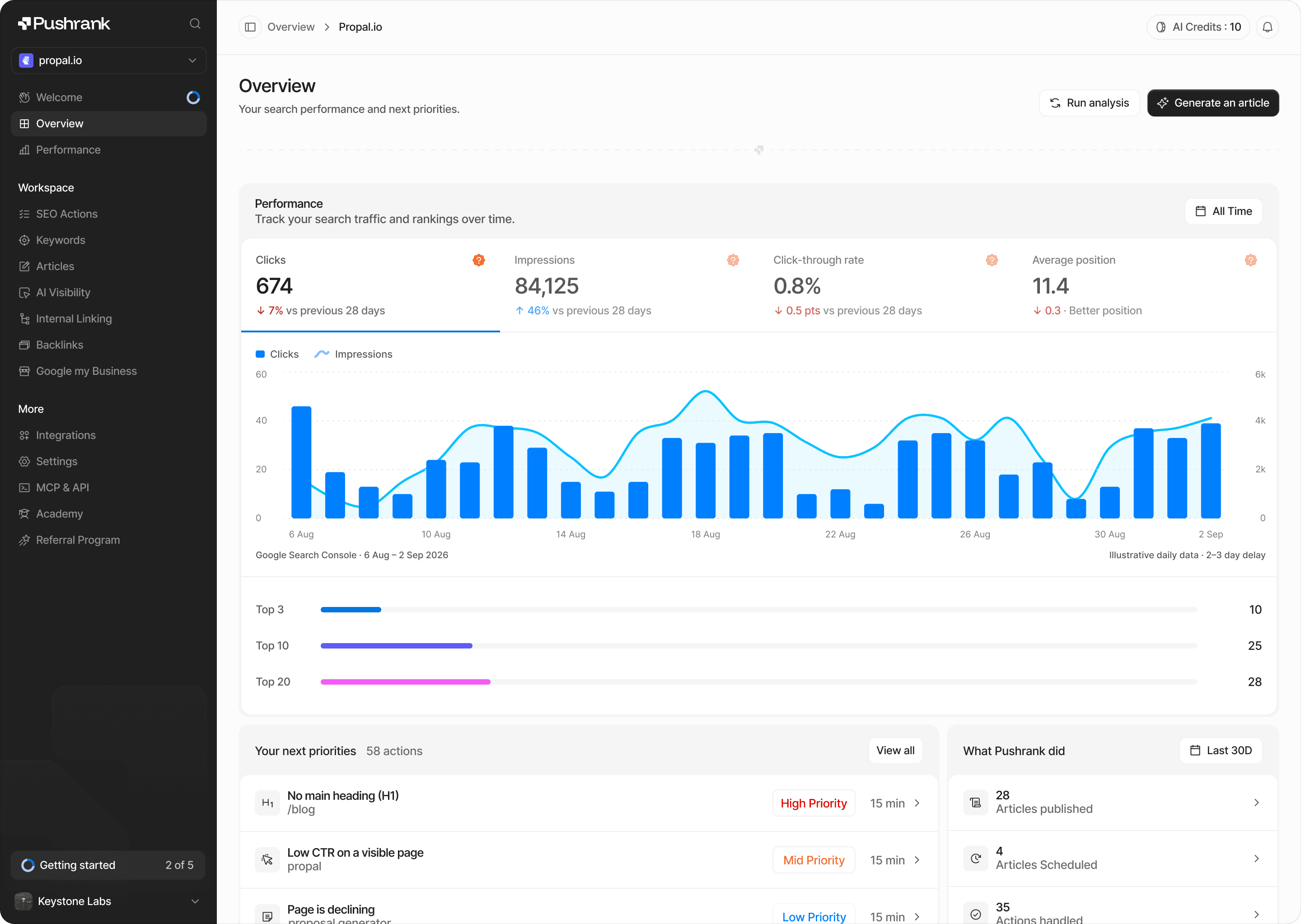
At Pushrank available at pushrank.io, our platform generates a prioritized daily action plan covering exactly these fixes.
In this article we break down each element.
Definition: On-Page SEO
On-page SEO is the practice of optimizing individual pages to rank higher and earn more relevant traffic, covering both the content and the HTML elements that describe it.
The defining characteristic is control. Everything in this discipline sits on your own site, editable today, with no dependency on third parties.
That distinguishes it from the two adjacent disciplines.
Off-page SEO happens elsewhere: links from other sites, brand mentions, citations. You influence it through outreach and content worth linking to, but you do not decide it.
Technical SEO governs how search engines access your site: crawling, indexation, site speed, structured data. It determines whether a page can rank at all.
On-page SEO answers a different question. Given that a page can be found, does it deserve to rank for what someone searched?
Two components make it up.
Content optimization, meaning the substance itself: does the page answer the query, cover the topic adequately, and match the intent behind the search?
HTML optimization, meaning the signals that describe that content: title tags, meta descriptions, headings, image attributes and internal links.
One misconception worth correcting early. On-page SEO is not keyword placement.
Repeating a term across a page stopped working years ago, and modern search engines evaluate whether content satisfies the searcher rather than whether it contains the right phrases.
What Is the Difference Between On-Page and Off-Page SEO?
Both aim at the same outcome through entirely different mechanisms. Here is the comparison.
On-page versus off-page SEO
Criterion | On-page SEO | Off-page SEO |
|---|---|---|
Location | Your own site | Other websites |
Control | Complete | Indirect |
Main elements | Content, titles, headings, internal links | Backlinks, mentions, brand signals |
Speed of change | Immediate | Weeks to months |
Cost | Time and content production | Outreach, partnerships, PR |
Question answered | Does this page deserve to rank? | Is this site worth trusting? |
Measurement | Direct, per page | Indirect, domain-level |
Risk | Low, reversible | Higher, penalties possible |
Where to start | Here | After the basics are solid |
As the table shows, the decisive difference is control.
You can rewrite a title tag this afternoon and see the effect within days. You cannot decide that another site links to you, however good your content is.
That asymmetry has a practical consequence most teams get backwards.
On-page work should come first, because it is faster, cheaper and entirely within your reach. Building backlinks to a page that does not match search intent wastes the authority you worked to earn.
Two further differences deserve attention.
Risk sits unevenly between the two. On-page mistakes are reversible: you fix a title, you rewrite a section, the damage disappears. Off-page tactics carry real penalty exposure, particularly anything resembling link buying.
Measurement differs in kind. On-page results attach to specific pages, which makes cause and effect traceable. Off-page results accrue at domain level, where attribution becomes considerably harder.
One point the table understates: the two are not alternatives. A page with excellent on-page optimization and zero authority struggles in competitive niches, and a strong domain with poorly optimized pages leaves traffic on the table.
Sequence them rather than choosing between them.
What Are the Key On-Page SEO Elements?
Six elements make up the discipline, ordered by the impact they actually have.
Content quality and intent match
This outweighs everything below it combined.
Before optimizing anything, establish what the searcher wants. Someone typing a question needs an answer, someone comparing products needs a comparison, someone ready to buy needs a product page.
A page that misreads intent cannot rank regardless of how well its tags are written.
Depth matters, length does not. Cover the topic adequately rather than padding toward an arbitrary word count.
Title tags
The single highest-return technical element.
Your title appears in search results and determines whether anyone clicks. Keep it under roughly 60 characters, place your primary term naturally, and write it as a promise rather than a label.
One title per page, never duplicated across your site.
Meta descriptions
These do not influence rankings directly, which leads many to skip them.
They influence click-through rate, which influences everything downstream. Around 155 characters, written to earn the click rather than to describe the page neutrally.
Heading structure
One H1 per page, matching the subject. H2 tags for main sections, H3 for subsections beneath them.
The hierarchy serves two audiences simultaneously: readers scanning for the part they need, and crawlers understanding how your content is organized.
Skipping levels or using headings for visual styling breaks both.
Internal linking
The most underused element on this list.
Internal links distribute authority across your site and tell search engines which pages you consider important. They also keep visitors moving through your content.
Use descriptive anchor text rather than generic phrases, and link from your strongest pages toward the ones you want to rank.
Images and media
Three things matter: descriptive file names, alt text that genuinely describes the image, and compressed files that load quickly.
Alt text serves accessibility first and SEO second, and writing it properly handles both.
One element deserves a final mention: your URL. Keep it short, readable and stable, since changing it later requires redirects.
How Do You Optimize a Page Step by Step?
Seven steps, in this order. The sequence matters as much as the actions.
Identify the target query and its intent
Check what currently ranks for it
Build or rewrite the content to match
Write the title tag and meta description
Structure the headings
Add internal links in both directions
Optimize images and check load speed
The first step determines everything downstream. Identify the intent, not just the keyword.
Someone searching a question wants an answer. Someone comparing wants a comparison. Someone ready to buy wants a product page. Optimizing a guide for a transactional query fails regardless of execution.
The second step saves you from guessing. Open the current results and examine what format dominates.
If the first page is entirely comparison articles, Google has already told you what it considers relevant. Arguing with that costs months.
The third step carries the weight. Write or rewrite the content to cover the topic adequately and answer the query directly.
Address the question in the opening rather than three sections down. Searchers who scroll looking for an answer frequently leave before finding it.
The fourth step earns the click. Title under roughly 60 characters, meta description near 155, both written as promises rather than descriptions.
The fifth step organizes. One H1, H2 tags for main sections, H3 beneath them. No skipped levels.
The sixth step is the one most people stop before reaching. Link from this page to relevant others, and to this page from your stronger existing content.
The seventh step prevents avoidable losses. Compressed images, descriptive file names, meaningful alt text.
One habit worth adopting: recheck after thirty days. On-page work is iterative, not a single pass.
Common On-Page SEO Mistakes
Several errors appear repeatedly, and most cost rankings without producing any obvious signal.
Optimizing for the keyword rather than the intent behind it
Repeating the target term across the page unnaturally
Duplicating title tags across multiple pages
Writing titles that describe rather than titles that promise
Using multiple H1 tags or skipping heading levels
Treating headings as styling rather than as structure
Ignoring internal links entirely
Using generic anchor text like “click here” or “read more”
Leaving alt text empty or stuffing it with keywords
Targeting the same query across several pages
Among these, intent mismatch causes the most wasted effort, and it is the hardest to see.
You write an excellent guide, optimize it properly, and it never ranks. The reason is rarely quality: the query wanted a comparison page, or a product page, and no amount of on-page work overrides that.
Open the current results before writing. If every ranking page shares a format you did not choose, that is your answer.
Keyword repetition persists despite having stopped working years ago.
Modern search engines evaluate whether content satisfies the searcher, not whether it contains the right phrases at the right density. Repetition now signals low quality rather than relevance.
Cannibalization is the error that compounds silently. Several pages targeting the same query split your authority between them, and none ranks as well as a single consolidated page would.
Audit your site for this before creating anything new. It is more common than most teams realize.
Generic anchor text wastes the strongest internal signal you control. “Read more” tells search engines nothing about the destination, where a descriptive phrase tells them exactly what the linked page covers.
At Pushrank available at pushrank.io, our platform detects cannibalization and surfaces these fixes as a prioritized daily action plan.