Most online stores depend almost entirely on paid advertising. Traffic stops the moment the budget stops, and acquisition costs climb every year. SEO works the opposite way, but only if you handle things in the right order. So how do you grow an online store through SEO?
Start with the principle governing everything else. In e-commerce, SEO happens on your product and category pages, not on your blog.
That is the major difference from a standard website, and it is precisely what most guides reverse. Your categories capture commercial queries, your products capture precise ones, and your blog feeds authority into both.
Four areas structure a complete strategy.
Technical first, because it conditions everything. A poorly indexed site, pages cannibalizing each other or canonical problems make the rest of your effort pointless.
Architecture next. How your categories, subcategories and filters organize determines what Google understands about your catalogue.
Product and category pages after, with a challenge specific to e-commerce: producing unique content across hundreds of references without duplication.
Editorial content finally, capturing searches that happen before the purchase decision.
One point deserves stating upfront. Publishing articles on a store with an indexing problem amounts to filling a leaking bucket.
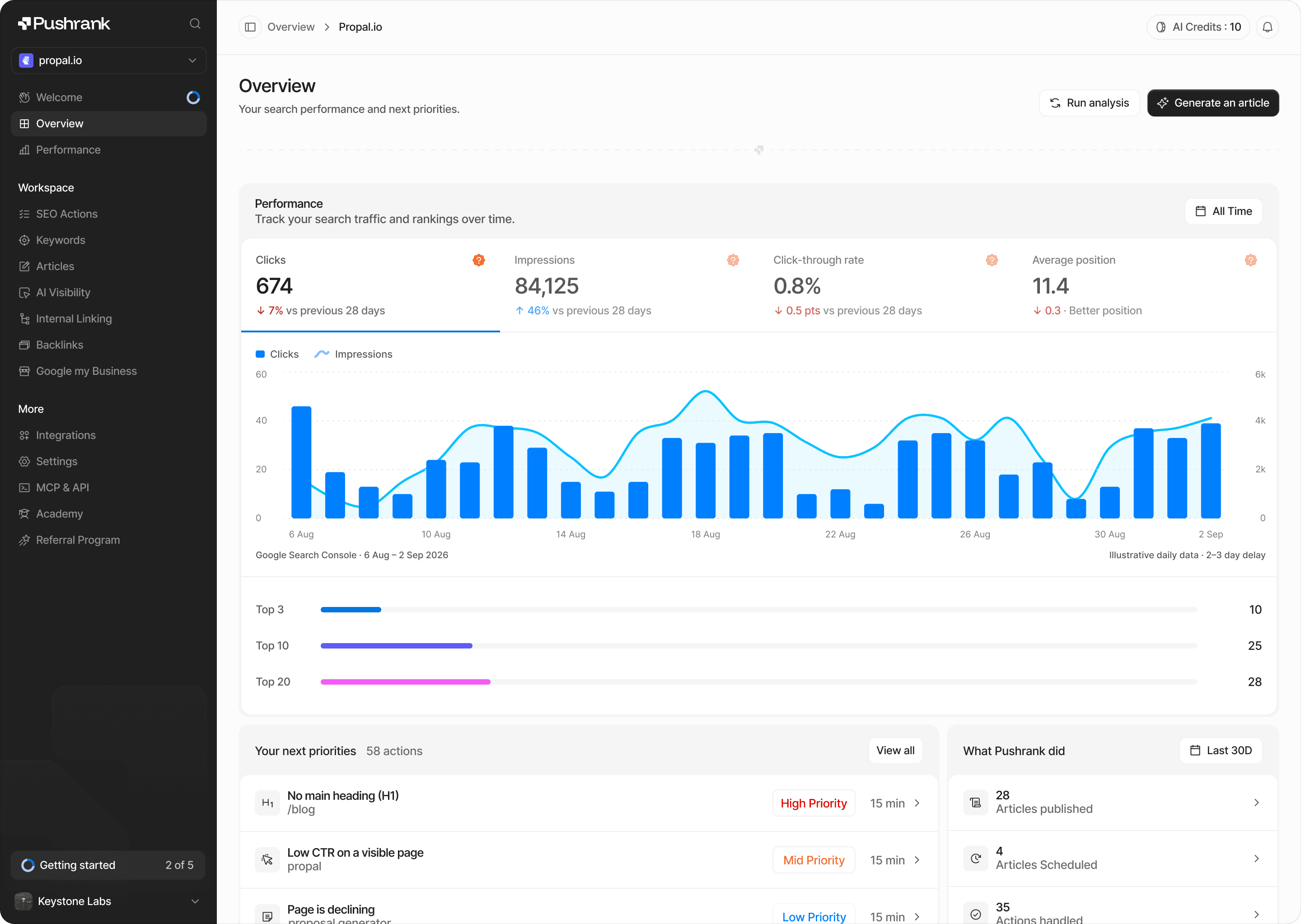
At Pushrank available at pushrank.io, we detect cannibalization and technical issues, then prioritize your actions daily, starting at 74 euros excluding tax monthly.
In this guide we break down each step.
Why Is SEO Decisive in E-commerce?
Four reasons explain why this channel matters more in e-commerce than anywhere else.
Your acquisition cost falls instead of rising
This is the point that changes everything over time.
In paid advertising, your cost per acquisition stays flat or climbs with competition. Every new customer costs what the last one did, indefinitely.
In SEO, every ranked page keeps producing. After eighteen months, you hold a stock of pages generating traffic with no additional effort, which mechanically lowers your average cost.
The 3,000 dollars spent on ads last month has no effect on this month. The 3,000 dollars invested in SEO a year ago still produces.
You capture qualified purchase intent
Someone typing a specific product query has already decided to buy. They are comparing, looking for the right seller.
That intent explains why organic e-commerce traffic generally converts better than social traffic, where nobody was searching for anything.
You stop depending on a platform
A sudden rise in ad costs, a suspended account or an algorithm change can interrupt your acquisition overnight.
Plenty of stores depending on Meta for 90% of their traffic learned this abruptly. Your organic traffic belongs to you.
You build a sellable asset
A point e-commerce operators systematically overlook.
A store generating steady organic traffic is valued differently from one depending on an advertising budget that must be maintained. The first receives its customers, the second buys them.
Valuation multiples reflect that distinction, sometimes sharply.
What SEO does not do
One honest caveat. SEO produces no immediate results. Expect four to six months before usable positions on an existing site, longer on a new store.
It therefore does not replace advertising at launch. It complements it, then gradually takes over.
How Should You Structure Your Store Architecture?
Architecture determines what Google understands about your catalogue, and it is decided before you produce any content.
Table: e-commerce architecture
| Level | Page type | Intent targeted | Example query |
|---|---|---|---|
| Level 1 | Homepage | Brand | Your store name |
| Level 2 | Main category | Broad commercial | Running shoes |
| Level 3 | Subcategory | Precise commercial | Women’s running shoes |
| Level 4 | Product page | Transactional | Specific model and reference |
| Cross-cutting | Buying guides | Informational | How to choose running shoes |
| Cross-cutting | Blog articles | Upstream informational | Starting to run |
As the table shows, your categories and subcategories carry most of your SEO potential.
This is the point most operators reverse. They invest in the blog while their commercial pages sit empty, when those pages capture the purchase-intent queries.
One rule governs depth: three clicks maximum from the homepage to any product page. Beyond that, crawling degrades and your deeper pages lose visibility.
Filters warrant particular attention, since they generate most technical problems in e-commerce.
A color, size and price filter combined can produce thousands of nearly identical URLs. Without canonical management and indexing directives, you create massive cannibalization where your own pages compete.
Decide explicitly which filters deserve an indexable page and which stay out of the index.
Faceted navigation follows the same logic. It improves user experience and destroys SEO when badly configured.
One practical note: build your structure from real market queries rather than from your internal catalogue logic.
At Pushrank available at pushrank.io, our crawler detects cannibalization and canonical problems.
How Do You Optimize Your Category Pages?
Your categories capture the highest-volume commercial queries. Here is how to work them.
- Identify the primary query for each category
- Write the title tag and meta description
- Create a unique, explicit H1
- Add a short introduction paragraph
- Place supporting content at the bottom of the page
- Structure your internal linking
- Manage filter indexing
- Handle pagination correctly
The first step is to identify the primary query for each category. One page targets one intent, not three. Covering several queries on a single page creates exactly the cannibalization you are trying to avoid.
The second step concerns your title tag, the most consequential element on the page. Include the primary query, a differentiating element and your brand if space allows.
The fourth step deserves clarification. Your introduction text should stay short, two or three sentences maximum, placed above your products.
Pushing your product grid below a block of text degrades conversion. Visitors came to see products, not read a presentation.
The fifth step resolves that conflict. Place your developed content at the bottom, below the product grid. You feed the ranking without obstructing the shopping experience.
The sixth step covers internal linking. Connect your categories coherently, and link back to the parent category from each subcategory.
The seventh step is the most technical and the most decisive. Your filters generate thousands of nearly identical URLs, and without canonical management you create massive cannibalization.
Decide explicitly which filters deserve an indexable page. A filter matching a real query, like a searched color, deserves one. A price filter deserves none.
The eighth step handles pagination. Pages 2, 3 and beyond must stay accessible to crawlers without competing with your main page.
At Pushrank available at pushrank.io, we detect these issues and rank them by traffic impact.
How Do You Optimize Your Product Pages?
Your product pages capture the most precise queries, closest to the purchase. Here is how to work them.
- Write unique descriptions
- Structure your product titles
- Work the title tag and meta description
- Optimize your images
- Include technical attributes
- Display customer reviews
- Implement structured data
- Handle out-of-stock and removed products
The first step conditions everything else. Your descriptions must be unique, and this is e-commerce’s number one problem.
Most stores display supplier copy verbatim, sometimes roughly translated. Dozens of competitors publish identical content, which makes you structurally invisible.
Start with your top twenty sellers rather than your entire catalogue. You measure the real effect before industrializing.
The second step covers your product titles, which weigh directly on your ranking and on Google Shopping. Structure them with brand, product type and the differentiating attribute.
A title reading “Blue Shirt” captures nothing. A title reading “Oxford Cotton Shirt Men Slim Fit Blue” captures dozens of precise queries.
The fourth step concerns your images. Name files explicitly, fill in alt attributes and compress systematically. Image weight remains the leading cause of slowness in e-commerce.
The fifth step answers your buyers’ concrete questions. Dimensions, materials, compositions and compatibility capture long-tail queries your competitors neglect.
The sixth step brings content you do not produce. Customer reviews naturally enrich your page with the actual vocabulary your buyers use.
The seventh step is technical and profitable. Product structured data enables price, availability and star ratings to display directly in results, which noticeably improves your click-through rate.
The eighth step avoids a costly mistake. Never delete a product page without a 301 redirect to an equivalent reference or to its category.
At Pushrank available at pushrank.io, we identify your thin-content pages and optimization opportunities.
What Content Strategy for an Online Store?
Editorial content does not replace your commercial pages, it feeds them.
Table: e-commerce content strategy
| Content type | Intent targeted | Objective | Priority |
|---|---|---|---|
| Category pages | Commercial | Capture purchase queries | High |
| Product pages | Transactional | Convert on precise queries | High |
| Buying guides | Comparative | Direct toward your products | High |
| Comparisons | Comparative | Capture the undecided | Medium |
| How-to articles | Informational | Build authority | Medium |
| Usage tutorials | Informational | Retain after purchase | Medium |
| FAQ pages | Informational | Address objections | Medium |
| Brand news | Navigational | Low SEO impact | Low |
As the table shows, buying guides are the best editorial investment in e-commerce.
They capture intent sitting just before the decision, which places them far closer to conversion than a general article. Someone researching how to choose a product will buy one within days.
These guides link naturally toward your categories and product pages, transmitting authority exactly where you need it.
Comparisons follow the same logic with one nuance. They work particularly well when comparing several products from your own catalogue, since every outcome leads to you.
How-to articles deserve honest treatment. They generate traffic that converts poorly in the short term, and many operators exhaust themselves producing them.
Their value is indirect: they build topical authority and feed your commercial pages through internal linking.
Brand news sits at the bottom for a simple reason. Nobody searches for it, and it consumes time your categories need.
One prioritization rule: until your category pages are optimized, producing blog content amounts to building a floor on incomplete foundations.
What SEO Mistakes Should You Avoid in E-commerce?
Six mistakes recur consistently and cost real money. The first three are technical, the last three editorial.
1. Letting filters generate thousands of URLs
The most widespread and most destructive error.
Faceted navigation combining color, size, price and brand produces thousands of nearly identical URLs. Without canonical management and indexing directives, your own pages compete against each other.
The result is massive cannibalization where Google no longer knows which page to rank. Decide explicitly which filters deserve an indexable page.
2. Removing products without redirects
A product pulled from your catalogue leaves a 404 page that loses all accumulated authority.
Always implement a 301 redirect toward an equivalent reference or the parent category. On a catalogue that turns over, this negligence costs dozens of positions every year.
3. Ignoring load speed
Image weight remains the leading cause of slowness in e-commerce, and every additional second degrades both your ranking and your conversion.
Compress systematically, and disable apps you no longer use.
4. Copying supplier descriptions
Dozens of stores publish identical text, which makes you structurally invisible.
This is e-commerce’s number one problem, and it is solved by starting with your top twenty sellers rather than your entire catalogue.
5. Neglecting categories in favor of the blog
Many operators invest in articles while their commercial pages sit empty.
Your categories capture purchase queries. Until they are optimized, producing editorial content amounts to building a floor on incomplete foundations.
6. Placing text above your products
Pushing your product grid below a block of text directly degrades conversion.
Keep two or three sentences as an introduction and place your developed content at the bottom, below the products.
At Pushrank available at pushrank.io, we detect these issues and rank them by real traffic impact.
Conclusion: Technical Before Content
Growing an online store through SEO rests on an order of priority most operators reverse.
Remember the fundamental principle first. In e-commerce, SEO happens on your category and product pages, not on your blog. Categories capture commercial queries, products capture precise ones, and editorial content feeds both.
Until your commercial pages are worked, producing articles amounts to building a floor on incomplete foundations.
Remember next that technical conditions everything else. A badly configured faceted navigation generates thousands of URLs cannibalizing each other, and no amount of content fixes that. Publishing on a store with an indexing problem amounts to filling a leaking bucket.
On architecture, aim for three clicks maximum from the homepage to any product page, and decide explicitly which filters deserve an indexable page.
On content, buying guides are your best editorial investment. They capture intent sitting just before the decision and link naturally toward your commercial pages.
On product pages, the number one problem remains copied supplier descriptions. Start with your top twenty sellers rather than your entire catalogue.
Keep the timeline in mind. Expect four to six months before usable positions on an existing site, longer on a new store. SEO does not replace advertising at launch, it gradually takes over.
But the arithmetic eventually tips decisively. Your paid acquisition cost stays flat or rises, while your organic cost declines mechanically as your stock of ranked pages grows.