SEO aims to rank your page. AEO aims to make your page the answer. That one-line distinction explains almost everything that follows, and it is the part most teams get wrong when they start treating the two as interchangeable.
Search Engine Optimization is the discipline everyone knows: you optimise a page so that search engines rank it highly for a query, the user sees a list of results, clicks one, and lands on your site. Success is a position, and the reward is a visit.
Answer Engine Optimization works differently. An answer engine does not hand the user a list: it extracts a passage from a page and displays it as the answer. Featured snippets, People Also Ask boxes, knowledge panels and voice assistant responses all work this way. Success is no longer a position, it is ownership of the answer, and the reward is visibility rather than always a click.
That trade-off is the heart of the matter. Winning an answer box often means the user gets what they came for without visiting your site. In exchange, you appear above every organic result, your brand is the one cited, and on voice search you are the only response returned at all. For most businesses, that exchange is worth making.
What makes this confusing is how much the two overlap. AEO is not a separate strategy: it runs on the SEO foundation. Answer engines extract from pages that are crawlable, indexed and ranking. If your site cannot be crawled or does not appear in results, there is nothing to extract.
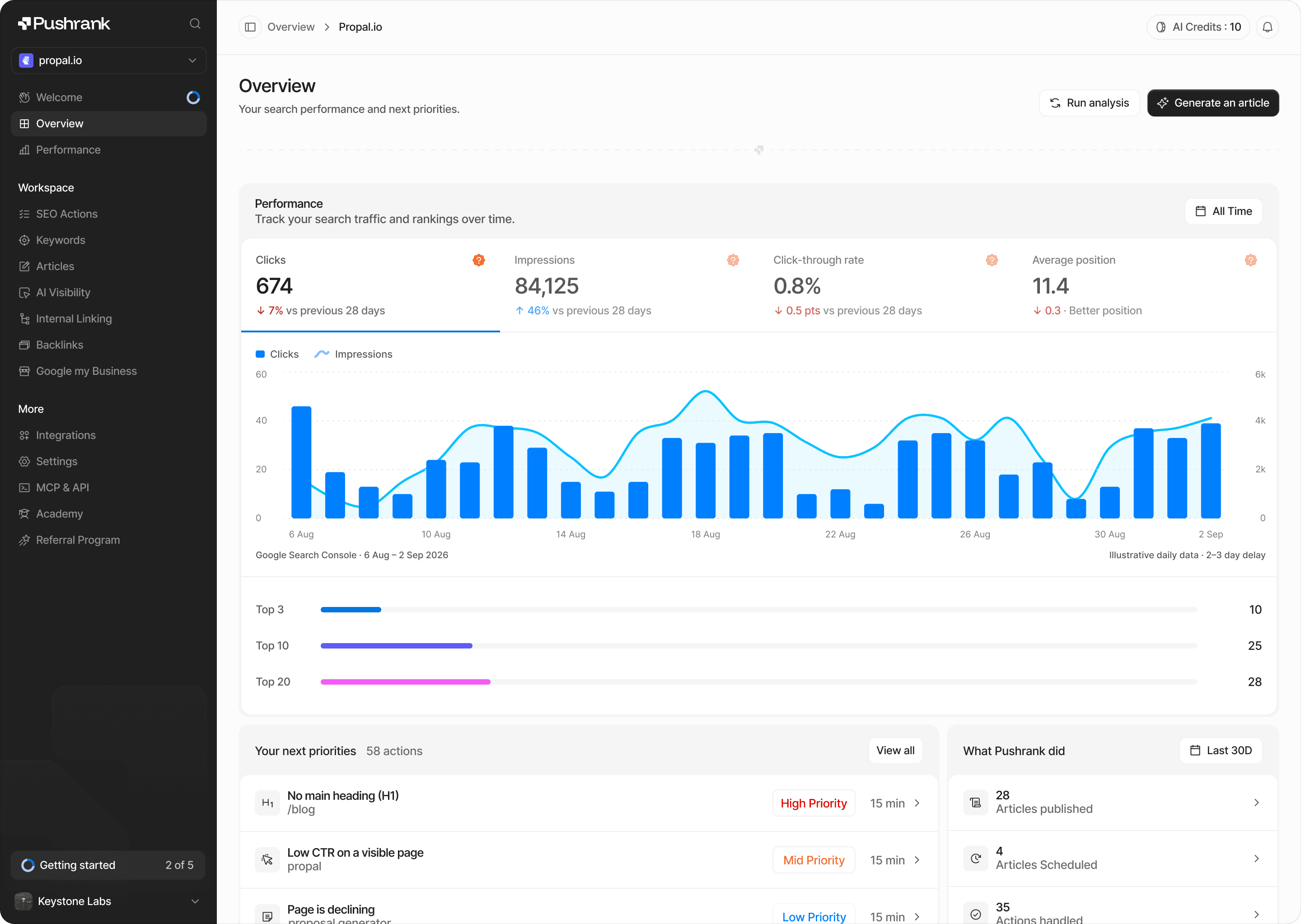
That shared foundation is exactly where Pushrank operates. Rather than handing you another dashboard, it does the work of an SEO: its crawler audits the structural layer that decides whether an engine can extract an answer at all, from indexability and canonicals to heading structure and cannibalisation between your own pages. It connects to Search Console so the recommendations sit on your real queries, tracks your visibility across ChatGPT, Claude and Gemini, and turns the whole thing into a prioritised action plan updated every week. There is also a free Chrome extension that audits any page in one click, no account required.
This article sets out exactly what each discipline means, where they genuinely differ, what they share, how to measure each one, and which deserves your attention first depending on what you sell.
What is SEO, exactly?
SEO stands for Search Engine Optimization: the practice of improving a website so that search engines rank its pages highly for the queries your audience actually types. The output is a position in a list of results, and the reward is a visit to your site.
It rests on three pillars, and all three have to hold.
Technical SEO determines whether your pages can be found and understood at all. Crawlability, indexation, site architecture, loading speed, mobile rendering, canonical tags, structured data. None of this is visible to a visitor, and all of it decides whether anything else matters. A page that cannot be crawled does not rank, however good its content is.
On-page SEO covers what sits on the page itself: the keyword targeted, the title tag and meta description, the heading hierarchy, the depth and accuracy of the content, internal links, image attributes. The rule that governs this layer is one page, one primary keyword. Two pages chasing the same query compete against each other and both underperform, which is the most common self-inflicted problem on growing sites.
Off-page SEO is everything that happens elsewhere and shapes how much authority your domain carries: backlinks from relevant sites, brand mentions, and the general signals that tell an engine you are a credible source on a subject.
Across all three, the organising principle is search intent. A query where every ranking result is a blog article will not reward a product page, and the reverse is equally true. Reading the results page before writing anything is what separates SEO that works from SEO that produces content nobody finds.
What makes SEO durable is that it compounds. A page that ranks keeps earning visits for months or years without further spend, which is the opposite of paid acquisition. What makes it demanding is the timeline: six to twelve months is a realistic horizon on a competitive subject, and results arrive as a curve rather than a switch.
The practical difficulty is rarely knowing what to do. It is knowing what to do first, on which page, this week. That gap between analysis and execution is where most SEO stalls, and it is the reason Pushrank turns its crawl and your Search Console data into a prioritised weekly action plan rather than a report to interpret.
What is AEO, exactly?
AEO stands for Answer Engine Optimization: structuring content so that a system can extract a direct answer from it and display that answer to the user, often without requiring a click.
The concept predates generative AI by several years. Featured snippets, People Also Ask boxes, knowledge panels and voice assistant responses are all answer engines in this sense. They take a question, locate a passage that resolves it, and present that passage as the response, with your page credited as the source. AEO is the discipline of making your page the one that gets lifted.
The mechanics are specific and largely structural. An answer engine needs a self-contained passage that resolves the query on its own, placed where it can be found, and written so it makes sense detached from the paragraph around it. That is why AEO work looks the way it does: pose the question explicitly as a heading, answer it in the first two or three sentences underneath, keep the answer short enough to display, and strip out the context and build-up that would make the passage unquotable.
Three elements support that structure. Question-based headings phrased the way people actually search. Structured data through schema markup, which tells the engine what kind of content it is looking at: FAQ, HowTo, Product, Organization. And factual precision, since an engine will not surface an ambiguous or unsourced claim as a definitive answer.
What AEO optimises for is a single-source result. Your passage is displayed, attributed to your page, more or less verbatim. You either own the snippet or you do not, and that binary outcome is directly verifiable: you can check whether you hold the answer box for a given query exactly as you would check a ranking.
The trade-off is well known. Winning the answer often means losing the click, because the user gets what they came for on the results page. In exchange you gain brand visibility, position above every organic result, and on voice search the status of being the only response returned.
One point is worth repeating: AEO does not replace SEO, it sits on top of it. Engines extract from pages that are already crawlable, indexed and ranking, which is why the structural audit that Pushrank runs on indexability, canonicals and heading hierarchy is the precondition rather than an optional extra.
The Differences Between SEO and AEO
Both disciplines pursue visibility in search, but they optimise for different outcomes and they are not measured the same way.
SEO | AEO | |
|---|---|---|
Full name | Search Engine Optimization | Answer Engine Optimization |
Core objective | Rank the page | Be the answer |
What the engine does | Returns a list of links | Extracts a passage and displays it |
Unit of success | Position in results | Ownership of the answer box |
Reward | A visit to your site | Visibility, often without a click |
Surfaces concerned | Organic results | Featured snippets, People Also Ask, knowledge panels, voice assistants |
Query type targeted | All intents | Questions with a clear, factual answer |
Content format rewarded | Depth, completeness, topical coverage | Short, self-contained, extractable answers |
Answer placement | Anywhere in the page | Immediately under the heading |
Role of structured data | Helpful | Central, schema drives eligibility |
Role of backlinks | Decisive | Indirect, through the ranking that precedes extraction |
Attribution | Your page is listed and clicked | Your passage is shown, credited to your page |
Number of winners | Ten per page of results | One per answer box |
Measurement | Average position, clicks, impressions | Snippet ownership, binary check |
Typical timeline | 6 to 12 months on a competitive query | Weeks, once the page already ranks |
Main risk | Ranking without converting | Winning the answer and losing the click |
Three differences deserve more than a row in a table.
The first is plurality versus exclusivity. An organic results page has ten positions. An answer box has one. SEO lets you win partially by ranking fourth; AEO does not.
The second is where the answer sits. In SEO, a page can satisfy intent anywhere in its body and still rank. In AEO, an answer buried four paragraphs down is invisible, because the engine extracts rather than reads. Restructuring existing pages so the answer appears immediately under each heading is the single highest-return AEO action available, and it costs nothing in new content.
What SEO and AEO have in common?
The differences get the attention, but the overlap is far larger than most teams assume. Here is what both disciplines depend on:
Crawlability and indexation
Content quality and accuracy
Clear heading hierarchy
Search intent alignment
Topical authority and depth
Page speed and mobile rendering
Structured data
Internal linking
Domain authority and backlinks
Content freshness
The reason these overlap is structural rather than coincidental: an answer engine extracts from the pages a search engine has already indexed and ranked. There is no separate web for answer boxes. If your page cannot be crawled, it cannot be ranked, and if it cannot be ranked, it will not be extracted. Every technical fundamental that governs SEO therefore governs eligibility in AEO, with no exception. Teams that invest in "AEO work" on a site with a broken technical base see nothing happen, and the reason is always this one.
The same applies to authority. Engines do not pick a random page to answer a question: they overwhelmingly extract from pages that already rank in the top ten for that query. Backlinks, brand mentions and topical depth remain decisive, even though their role in AEO is indirect. You do not earn an answer box with markup alone; you earn it by ranking first and being the easiest page to quote.
Search intent is shared too. Both disciplines require reading the results page before writing anything, because the format that ranks is the format Google expects. AEO simply adds a question: once I have the right format, is the answer extractable?
Where they diverge is only in the final layer. SEO asks whether the page satisfies the intent completely. AEO asks whether a specific passage resolves it immediately, in isolation, near the heading. Those two requirements are compatible: a well-built page answers the question in its first two sentences, then develops it in depth.
Should you focus on SEO or AEO first?
SEO. Every time. This is not a close call, and treating it as an open question is how teams waste a quarter.
The reason is mechanical rather than ideological. An answer engine does not invent its answer: it extracts a passage from a page that is already crawled, indexed and ranking. If your page is not in the top ten for a query, it is not in the pool of candidates for that query's answer box. You cannot win an answer you are not eligible for, and no amount of schema markup changes that.
Put plainly: AEO without SEO produces nothing. SEO without AEO still produces traffic, rankings and revenue. One is a prerequisite, the other is an optimisation layer, and the order is not negotiable.
That is also why "AEO agencies" selling snippet optimisation to sites with a broken technical base deliver nothing measurable. Blocked crawlers, unindexed pages, JavaScript-rendered content, thin topical coverage: these are SEO problems, and they are the actual reason the site is absent from answer boxes.
The practical sequence looks like this. Fix the technical base first: crawlability, indexation, canonicals, speed, mobile rendering. Build topical depth on the subjects where you want to be credible, because engines extract from sources that cover a question fully rather than partially. Get pages ranking on queries with real commercial value. Only then apply the AEO layer: restructure your openings so the answer sits immediately under each heading, add the relevant schema, and target question-based queries explicitly.
The good news is that this sequence is faster than it sounds, because the AEO layer applies to pages you already have. Your quick wins sit in positions 5 to 20: pages with real impressions that already rank but do not own the answer. Rewriting their opening paragraphs is a few hours of work and can produce a snippet within weeks, where a new article takes months.
This is exactly the logic Pushrank follows. It connects to your Search Console, identifies the pages closest to converting, audits the structural layer that decides extractability, and returns a prioritised plan updated weekly rather than a list of everything wrong with your site.
Frequently asked questions about SEO and AEO
Is AEO replacing SEO?
No. AEO runs on SEO. Answer engines extract passages from pages that are already crawled, indexed and ranking. A site absent from search results is absent from answer boxes, whatever its markup. AEO is a layer on top of the foundation, not a replacement for it.
Does winning a featured snippet reduce my traffic?
Sometimes, yes. The user often gets their answer without clicking, which is the trade-off built into AEO. What you gain is position above every organic result, brand visibility and, on voice search, status as the only answer returned. For most businesses that exchange is worth making, particularly on informational queries where the click was low-value anyway.
How long does AEO take to show results?
Far less time than SEO, but only on pages that already rank. Restructuring the opening of a page sitting in positions 5 to 20 can produce a snippet within weeks. On a page that ranks nowhere, the answer is: as long as SEO takes.
What is the single most effective AEO action?
Putting the direct answer in the first two or three sentences under each heading, before any context. Most pages bury the answer four paragraphs down, which makes them unextractable. This change costs nothing, applies to content you already have, and outperforms any markup addition.
Is schema markup enough to win an answer box?
No. Schema makes your content machine-readable and eligible for certain result types. It does not make you rank, and it does not compensate for a page that is not in the top ten. Valid markup guarantees eligibility, never display.
Can I do AEO on every query?
No, and trying is a waste of effort. AEO works on queries with a clear, factual answer: definitions, how-to questions, comparisons, pricing, specifications. Broad commercial queries and subjective topics rarely trigger answer boxes.