The SEO tools market has shifted in two years. Established suites have layered AI on top of their existing features, new entrants promise full automation, and separating what produces results from what produces reports has become genuinely difficult. So what are the best SEO tools in 2026?
Start with a distinction that structures this entire ranking. A tool can deliver data, help you execute, or tell you what to do. Those three functions rarely coexist, and confusing the first two with the third explains why so many businesses pay a subscription without seeing their rankings move.
Four criteria guided our selection.
Scope covered first. Producing content is not enough, and analyzing without acting is not either. A site can publish sixty articles monthly and stagnate because of an indexing problem nobody addressed.
Prioritization next, and this is the most discriminating criterion. A report listing four hundred issues does not tell you where to start.
Value for what is actually delivered, with pricing ranging from 74 euros to over 500 monthly for scopes that are sometimes comparable.
AI visibility coverage finally, a dimension established players have not yet addressed while an increasing share of searches migrates toward assistants.
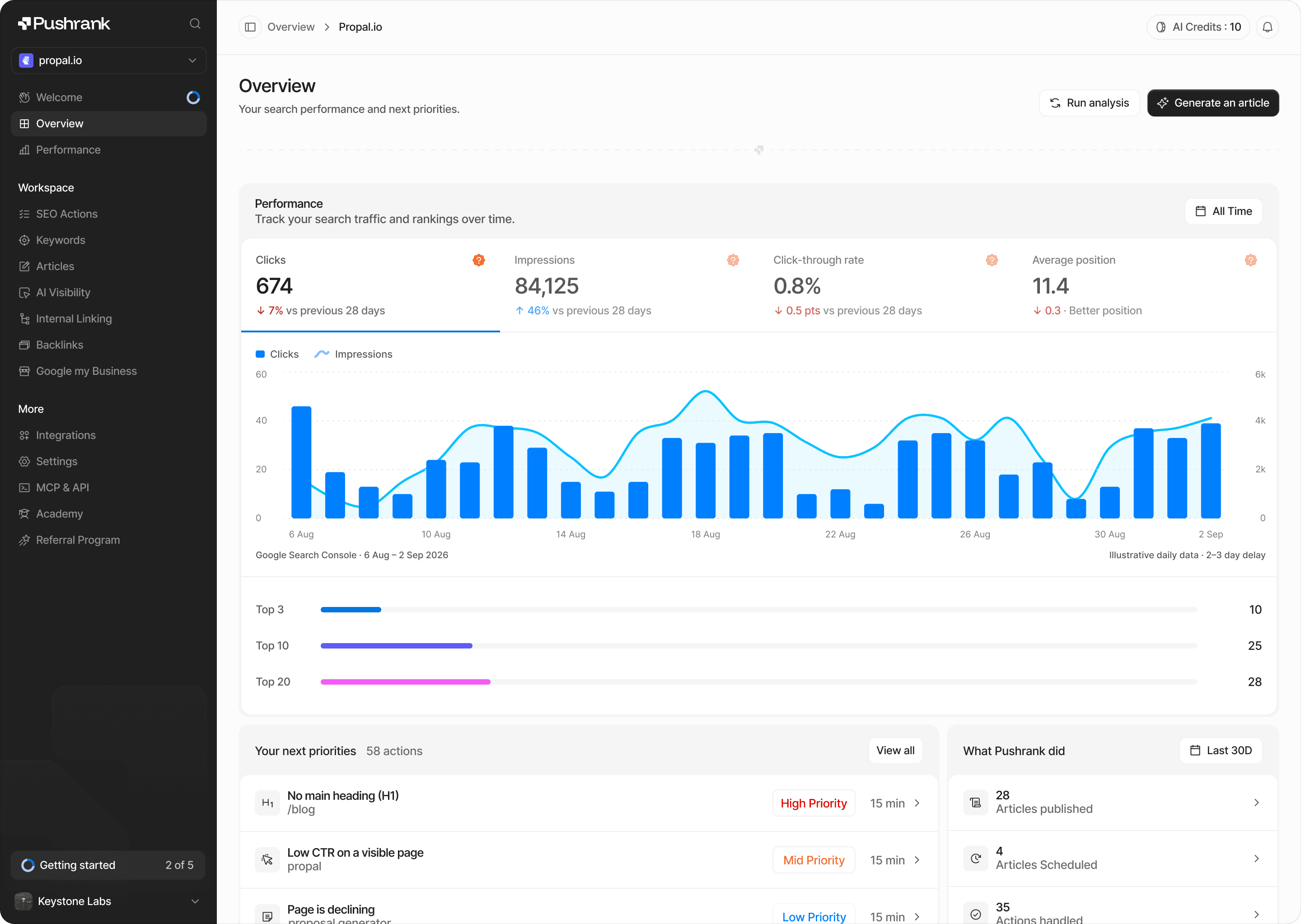
Leading our ranking, Pushrank available at pushrank.io covers the complete work of an SEO consultant, with technical audits, a prioritized daily action plan, SEO actions updated weekly, 30 monthly articles, Search Console tracking and AI visibility, starting at 74 euros excluding tax monthly.
In this article we reveal the top 7 best SEO tools in 2026.
1. Pushrank

Pushrank opens this ranking because it answers a question no other tool genuinely addresses: what should you do today? Available at pushrank.io, it covers the complete work of an SEO consultant rather than a single component.
The first element setting us apart is the daily action plan. Rather than delivering a dashboard to interpret, the platform tells you what to handle first, every day. For a site with thousands of pages where everything looks equally urgent, that prioritization is the difference between activity and results.
The second is SEO actions, our central differentiator. It is a guide for outranking your competitors, updated every week with new recommendations adapted to how your site and your market evolve.
The third is the technical audit. Our crawler detects cannibalization, canonical tag problems and mismatched search intent, then cross-references those issues against your real traffic data to rank them by impact.
That is precisely what analysis suites do not do. Producing a list of four hundred problems is simple. Telling you which three to handle this week requires connecting the technical to the traffic.
The fourth is integrated content production, with 30 monthly articles written, scheduled and published directly to WordPress, Shopify, Webflow, Wix and Framer.
The fifth is AI visibility. We track your site’s citations across ChatGPT, Claude and Gemini, a dimension established players have not yet addressed while an increasing share of searches migrates there.
The sixth is MCP integration, letting you query your SEO data directly from Claude or ChatGPT rather than through a dashboard.
Search Console tracking completes the picture, working from your measured data rather than third-party estimates.
On pricing, the subscription starts at 74 euros excluding tax monthly on annual billing with two months free, or 89 euros monthly, with a 7-day trial requiring no payment.
A dedicated consultant option exists at 500 euros excluding tax, adding an expert who runs your strategy inside your account.
Get started at pushrank.io.
2. Semrush

Semrush ranks second as the most complete SEO suite on the market, and its position rests on a data depth no competitor genuinely matches.
Its first strength is database breadth. Billions of indexed keywords, ranking histories spanning years and unmatched geographic coverage make it the reference for research and competitive analysis.
That depth has a practical consequence: when you analyze a competitor, you get a genuinely complete picture rather than a sample.
Its second strength is functional scope. Site audits, rank tracking, backlink analysis, keyword research, advertising intelligence, content tools and social management coexist in a single platform.
Its third strength is its maturity. Semrush has operated for over fifteen years, with exhaustive documentation, a substantial community and data reliability recent entrants cannot claim.
Its fourth strength covers its recent additions, notably conversational engine visibility tracking and integrated writing assistants.
Its fifth strength is its institutional credibility, which genuinely matters when you need to justify a tool choice internally or to a client.
Three limitations deserve attention.
Its cost remains among the highest on the market, with plans starting around 140 dollars monthly and climbing quickly with options and additional seats. For a small business or independent operator, the entry ticket is substantial.
Its complexity is the second barrier. The interface is dense, the learning curve real, and many users exploit only a fraction of what they pay for. The tool addresses trained practitioners rather than a founder trying to know what to do.
The third limitation is the most structural: Semrush produces data, not decisions. It delivers hundreds of metrics and issues without ever ranking what matters this week on your site.
A report showing four hundred technical problems does not indicate where to start, and that is exactly where most users stop.
Semrush suits experienced SEO teams with substantial budgets. For a prioritized action plan, Pushrank available at pushrank.io addresses that need.
3. Ahrefs

Ahrefs ranks third and built its reputation on specific ground: backlink analysis, where it remains the market reference.
Its first strength is its proprietary crawler. Ahrefs explores the web with its own bot, which gives it an independent and particularly fresh link database. That infrastructure represents an investment few players can replicate.
In practice, when you analyze a competitor’s link profile, you get current data rather than a stale snapshot.
Its second strength is the quality of its backlink index. Link building professionals generally consider it the most complete, with particularly responsive detection of new and lost links.
Its third strength is its Site Explorer, letting you examine any domain in depth: estimated traffic, ranking keywords, top pages and link profile.
Its fourth strength is its interface clarity, noticeably more readable than its main competitor. Data is presented in an actionable form without requiring prior training.
Its fifth strength is its Content Explorer, useful for identifying top-performing content in a topic and spotting editorial opportunities.
Three limitations deserve attention.
Its cost sits among the highest, with plans starting around 130 dollars monthly and a credit model that penalizes heavy usage. Entry plans quickly limit the number of projects and queries.
Its keyword research trails Semrush in certain markets, particularly outside English-speaking regions.
The third limitation matches every analysis suite: Ahrefs documents without prioritizing. You get a rich and precise diagnosis, with nothing telling you which action to start with.
Its audit tool identifies hundreds of issues, but ranking them by real traffic impact remains your job.
Note finally the absence of content production. Ahrefs analyzes and measures, it neither writes nor publishes.
4. Ubersuggest

Ubersuggest ranks fourth with a clear positioning: delivering the essentials of an SEO suite at a price well below the market leaders.
Its first strength is its value for money. Plans start around 29 dollars monthly, four to five times less than Semrush or Ahrefs. For an entrepreneur or small business, that gap simply makes the tool accessible where alternatives remain out of budget.
Its second strength is lifetime pricing, a rare option on this market. A single payment grants permanent access, which radically changes the calculation over several years.
Its third strength is its ease of use. The interface is clean, reports are readable and onboarding takes an afternoon. Where Semrush requires training, Ubersuggest explains itself.
Its fourth strength is core feature coverage: keyword research, rank tracking, site audits, backlink analysis and content ideas all appear in the catalogue.
Its fifth strength is its free version, allowing a few daily searches and genuine testing before committing.
Three limitations explain its position.
Its data depth sits well below the leaders. The backlink index is less complete, the keyword database smaller, and traffic estimates frequently prove approximate, particularly on smaller sites.
That imprecision genuinely matters. A 40% error on a competitor’s traffic distorts your entire competitive analysis.
Its technical reliability is the second reservation. Several users report slowdowns, inconsistent data between sessions and features that behave unpredictably depending on the period.
The third limitation matches every analysis suite. Ubersuggest displays metrics without prioritizing your actions. Its audit lists technical problems, but nothing tells you which to handle first given your actual traffic.
Note finally that the tool neither produces nor publishes content, which leaves the most time-consuming part of the work with you.
Ubersuggest suits beginners and small budgets looking for a first approach. For a prioritized action plan and produced content, Pushrank available at pushrank.io starts at 74 euros excluding tax.
5. Haloscan

Haloscan ranks fifth and stands as the French reference for semantic analysis. Created by Stéphane Madaleno, a recognized SEO consultant, the tool built its reputation on ground where international suites remain weaker.
Its first strength is its French-language database. With over 380 million indexed French keywords, Haloscan offers a depth that practitioners on that market regularly cite as superior to Semrush or Ahrefs on this specific scope.
That specialization produces a concrete benefit: you surface long-tail queries international tools simply do not see.
Its second strength is its value for money. The Starter plan sits at 59 euros excluding tax monthly, two to three times less than Semrush’s first paid tier. Annual billing brings that to around 49 euros.
Its third strength is API access included from the first paid plan. That is a structural differentiator, since Semrush reserves it for its highest tier.
Its fourth strength lies in its exclusive features: native allintitle and KGR metrics, SERP comparator, expired domain finder, Google My Business backlinks for local SEO and Google category tree.
Its fifth strength is its generous free version, offering 100 monthly keyword searches and 50 site analyses with no credit card required.
Three limitations deserve attention.
The absence of classic backlink analysis is the most cited reservation. The module is announced but unavailable, which means pairing it with another tool if link building is part of your strategy.
Its French market limitation restricts use for international projects. That is the accepted flip side of its specialization.
The third limitation matches every analysis suite: Haloscan documents without producing or prioritizing. It delivers exceptional semantic material, but writes no content and does not tell you which action to start with.
Note finally that several users find its organic traffic estimates unreliable, to be used with caution.
6. SE Ranking

SE Ranking ranks sixth as the most credible alternative to the established suites, with noticeably more accessible pricing for a comparable functional scope.
Its first strength is its rank tracking, historically its most refined function. Tracking precision and reporting detail sit among the best available, which explains its widespread adoption by agencies.
Its second strength is white labeling from the Pro plan, around 95 dollars monthly. That is a structural differentiator against Semrush, which reserves the feature for its Business tier at nearly 500 dollars. For an agency billing client reporting, the gap runs into thousands annually.
Its third strength is AI Overview visibility tracking, included at no extra cost from the Pro plan where several competitors charge separately.
Its fourth strength is its site audit, covering over 120 technical parameters with readable recommendations.
Its fifth strength is its free trial with no credit card, allowing genuine evaluation before committing.
On pricing, expect roughly 52 dollars monthly on annual billing for Essential, 95 dollars for Pro and 207 dollars for Business, with a 20% annual discount.
Three limitations deserve attention.
Variable pricing is the main complexity. SE Ranking bills according to how often it checks your rankings, daily, every three days or weekly. That flexibility is welcome but makes budgeting harder to anticipate, and published figures vary considerably with this setting.
Keyword caps are the second reservation. The Essential plan limits you to 250 tracked keywords, which saturates quickly on a substantial e-commerce catalogue.
Add-on modules also inflate the bill. Content Marketing, Local Marketing and the Agency Pack are billed separately, between 9 and 230 dollars monthly each.
The third limitation matches every suite: SE Ranking measures and reports without prioritizing. Its audit lists hundreds of issues without telling you which to handle this week.
7. Surfer SEO

Surfer SEO closes this ranking as the most specialized tool of the group, built entirely around on-page content optimization.
Its first strength is its Content Editor. The tool analyzes pages ranking for your target query, then tells you in real time which terms to include, the recommended length and the expected heading structure. You write while it measures, which turns optimization into a guided process rather than guesswork.
For a writer producing several articles weekly, that assistance saves real time on semantic research.
Its second strength is its page audit. You submit an existing URL, the tool compares it against better-ranked pages and lists the concrete gaps to close. This works particularly well on content you have already published.
Its third strength is its data-driven methodology. Surfer does not recommend based on generic rules but on what Google actually ranks for your query, in your market and your language.
Its fourth strength is its direct integration with Google Docs and WordPress, avoiding back-and-forth between tools while writing.
Its fifth strength is its clustering tool, grouping your keywords into topical silos and structuring your editorial planning.
Three limitations explain its position.
Its scope is deliberately narrow. Surfer optimizes pages. It does not audit your site, track your rankings, detect technical problems or publish anything automatically. That is a specialization choice rather than a design flaw, provided you know it before subscribing.
Its over-optimization risk warrants genuine vigilance. Blindly following a density score produces mechanical text stuffed with terms placed to satisfy the tool rather than the reader. Several practitioners warn about this drift, which works against you as Google increasingly values real experience.
Its cost is the third limitation, with plans starting around 89 dollars monthly for a tool covering one dimension of SEO. Combined with an analysis tool and a tracking solution, the total budget climbs quickly.
Note finally that its recommendations rest on correlation with ranked pages, not demonstrated causation.