AI applied to SEO has moved in two years from generating text to automating the work entirely. The market has filled with tools promising search rankings on autopilot, and sorting through them has become difficult. So what are the best AI SEO tools?
Start with a useful distinction. A content generator produces articles. An SEO agent analyzes your site, identifies what blocks it, prioritizes actions and measures results. The difference is considerable, and many tools sold as agents belong firmly in the first category.
Four criteria guide this ranking.
Scope covered first. Producing content is not enough. A site can publish sixty articles a month and stagnate because of indexing problems or cannibalization.
Analysis capability next, meaning the ability to audit your existing site rather than simply adding new pages.
Prioritization also, since a report listing four hundred issues does not tell you where to start.
Measurement finally, without which you will never learn what actually works.
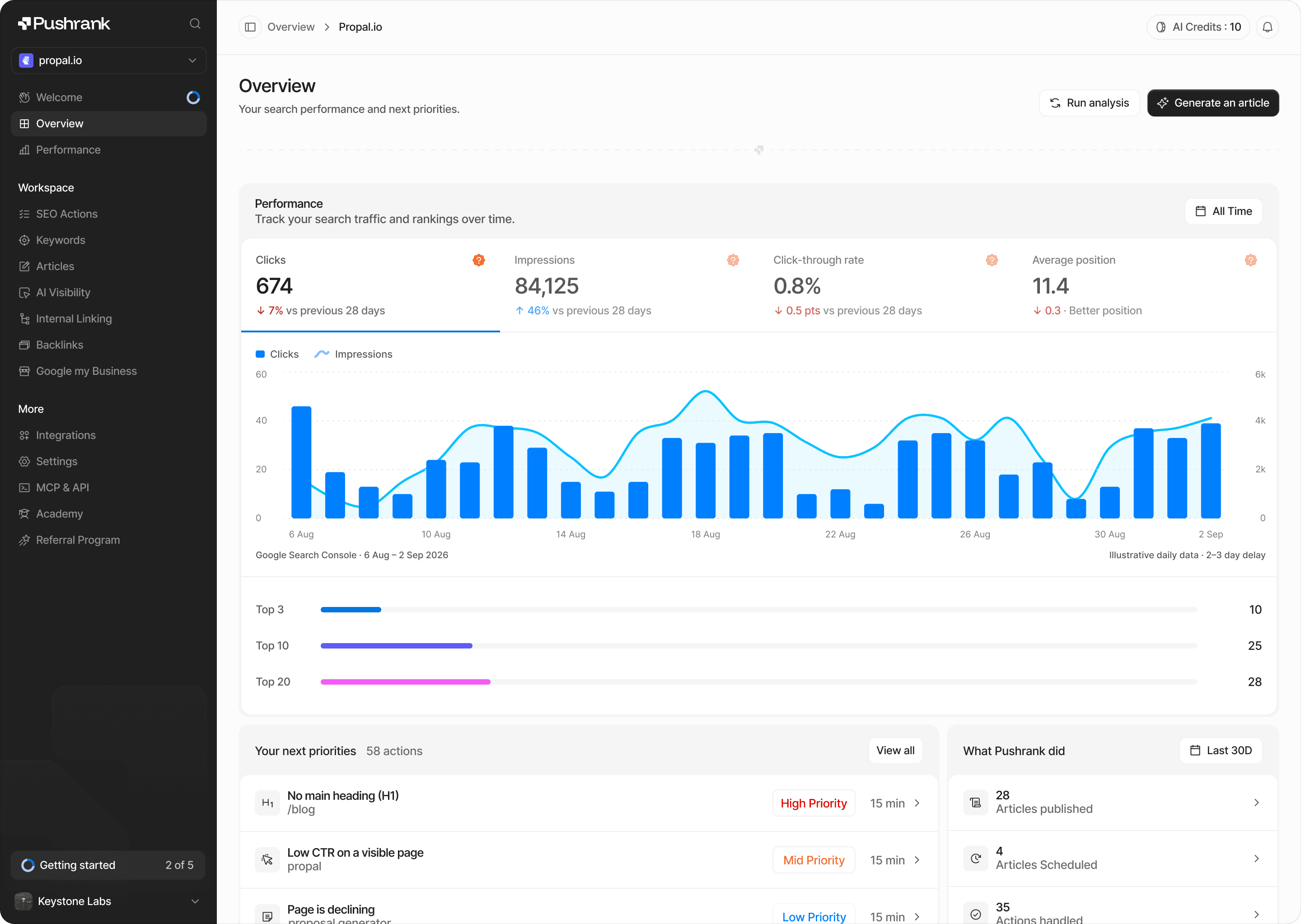
Leading our ranking Pushrank available at pushrank.io covers the complete work of an SEO consultant, with technical audits, a prioritized daily action plan, SEO actions updated weekly, Search Console tracking and AI visibility, starting at 74 euros excluding tax monthly.
In this article we reveal the top 6 best AI SEO tools.
1. Pushrank

Pushrank opens this ranking because it covers the complete work of an SEO consultant rather than a single component. Available at pushrank.io, it combines analysis, recommendations, production and measurement in one subscription.
The first element setting us apart is the daily action plan. Rather than handing you a dashboard to interpret yourself, the platform tells you what to do first, every day. For a site with thousands of pages where everything looks equally urgent, that prioritization is the difference between activity and results.
The second is SEO actions, our central differentiator. It is literally a guide for outranking your competitors, updated every week with new recommendations adapted to how your site and your market evolve.
The third is the technical audit. Our crawler detects cannibalization, canonical tag problems and mismatched search intent, then cross-references those issues against your real traffic data to rank them.
That is precisely what most tools do not do. Producing a list of four hundred problems is easy. Telling you which three to handle this week requires connecting the technical to the traffic.
The fourth is integrated content production, with 30 monthly articles written, scheduled and published directly to WordPress, Shopify, Webflow, Wix and Framer.
The fifth is AI visibility. We track your site’s citations across ChatGPT, Claude and Gemini, a dimension most established tools have not yet addressed while an increasing share of searches migrates there.
The sixth is MCP integration, letting you query your SEO data directly from Claude or ChatGPT rather than through a dashboard.
Search Console tracking completes the picture, working from your real data rather than third-party estimates.
On pricing, the subscription starts at 74 euros excluding tax monthly on annual billing with two months free, or 89 euros monthly, with a 7-day trial requiring no payment.
A dedicated consultant option exists at 500 euros excluding tax, adding an expert who runs your strategy inside your account.
Get started at pushrank.io.
2. Sorank

Sorank ranks second as a French platform automating both traditional search rankings and visibility in conversational engines.
Its first strength is its unified SEO and GEO dashboard. The platform tracks your mentions across ChatGPT, Perplexity, Gemini, Grok and Claude alongside your Google rankings, a dimension few tools address yet. For a business watching an increasing share of searches migrate to assistants, that measurement carries real commercial value.
Its second strength is end-to-end automation. The tool analyzes your site and your competitors, identifies commercially intent-driven keywords, builds semantic clusters, writes the articles with images and internal links, then publishes them directly to your CMS.
Its third strength is its backlink network pooling over 2,000 sites among its users, a resource with no direct equivalent among comparable players.
Its fourth strength is French-language support, a genuine differentiator in a market dominated by English-speaking players.
Its fifth strength is its 90-day guarantee, which far exceeds industry standards and removes much of the risk from committing.
On pricing, three plans billed per site: Essentiel at 99 euros excluding tax, Pro at 249 euros and Business at 499 euros, with 50% off annual billing and a 3-day trial.
Three limitations deserve attention.
Per-site billing is the most structural constraint. Three projects on Essentiel approaches 300 euros monthly, which places the tool in a different price bracket for an agency or multi-site operator.
The credit system also demands constant monitoring. Backlinks and keywords run on quotas, and several G2 users find backlink access costs high.
Automatic publishing without validation suits regulated sectors poorly, or any activity where each statement carries liability. Several analyses explicitly advise against the tool in those contexts.
Note finally that rank tracking remains less thorough than specialized suites.
Sorank suits single-site SMBs and e-commerce operators looking to produce volume. For a prioritized action plan with no credit system, Pushrank available at pushrank.io covers broader scope.
3. Claude

Claude ranks third with a necessary clarification: it is not an SEO tool but a general-purpose assistant developed by Anthropic. Its presence here comes down to what it becomes once connected to the right data.
Its first strength is writing quality. On editorial content production, Claude stands out with a writing standard noticeably above the average automated generator. Texts need less rewriting and sound less artificial, which matters when your credibility rests on what you publish.
Its second strength is analytical capability. You can hand it a Search Console export, a crawl or a rankings file and receive a structured reading rather than a list of observations. It identifies patterns a raw table does not reveal.
Its third strength is reasoning on complex problems. Deciding on a topic cluster strategy, choosing between two architectures or diagnosing a traffic drop are exercises where a conversational assistant contributes more than a rules-based tool.
Its fourth strength is the MCP protocol, which lets it connect to external data sources. That is precisely what turns a general-purpose assistant into an operational SEO tool.
At Pushrank, our MCP integration lets you query your SEO data directly from Claude: rankings, cannibalization, priority actions and recommendations, without going through a dashboard.
Three limitations must be stated clearly.
Claude has no crawler of its own. It cannot explore your site, detect your technical errors or analyze your structure without being supplied that data.
It offers no rank tracking. No continuous measurement, no history, no alert on a traffic drop.
It publishes nothing. No native CMS integration, no editorial scheduling.
Put plainly, Claude alone does not do SEO. Claude connected to SEO data becomes formidable on analysis and decision-making.
On pricing, a free version exists, with paid plans starting around 20 dollars monthly.
Claude works perfectly as an analysis and writing layer. For the data it lacks, Pushrank available at pushrank.io supplies it through MCP.
4. Outrank

Outrank ranks fourth as an automated SEO publishing platform, designed to handle the entire editorial cycle without human involvement.
Its first strength is its CMS coverage, the broadest in its category. WordPress, Webflow, Shopify, Notion, Wix, Framer, Ghost and a webhook system are supported natively. Automated publishing genuinely removes a step, and few alternatives offer that level of integration.
Its second strength is its volume-to-price ratio. At 99 dollars for 30 monthly articles, each publication costs roughly 3.30 dollars. Annual billing at 999 dollars brings that lower still, saving 189 across the year.
Its third strength is pricing simplicity. A single plan, everything included, no credits to monitor and no modules to weigh. Users are unlimited and over 150 languages are covered.
Its fourth strength is its technical tooling, with a REST API and command-line interface letting you integrate the platform into automated workflows or drive it through AI agents.
Its fifth strength is unlimited keyword research, through a conversational interface with live volume and difficulty data.
Three limitations explain its position.
Outrank produces new content without ever analyzing your existing site. No rank tracking, no technical audit, no recommendations on what you have already published. You generate volume without knowing what ranks or what blocks you technically.
That is the tool’s structural limit. Publishing thirty monthly articles on a site with indexing problems amounts to filling a leaking bucket.
The Backlink Exchange calls for an explicit caution. This reciprocal arrangement between platform users draws documented concerns from several third-party analyses, under Google’s link scheme guidelines. Enabling it without weighing the implications creates real exposure on your domain.
Strategy dictated by the tool raises a deeper question. The editorial calendar generates automatically, which removes your control over your commercial priorities.
5. Semrush

Semrush ranks fifth as the most complete SEO suite on the market, enriched in recent years with AI-assisted features. Its presence in an AI tools ranking deserves a nuance, however: this is an analysis platform with AI layers added, not an agent built around automation.
Its first strength is database depth. Billions of keywords, ranking histories spanning years and unmatched geographic coverage make it the reference for research and competitive analysis.
Its second strength is functional breadth. Site audits, rank tracking, backlink analysis, keyword research, advertising intelligence and content tools coexist in a single platform. Few tools cover as much ground.
Its third strength is its maturity. Semrush has operated for over fifteen years, with exhaustive documentation, a substantial community and data reliability recent entrants cannot claim.
Its fourth strength covers its recent AI additions, notably conversational engine visibility tracking and integrated writing assistants.
Its fifth strength is its institutional credibility, which matters when you need to justify a tool choice internally or to a client.
Three limitations deserve attention.
Its cost is the highest in this ranking, with plans starting around 140 dollars monthly and climbing quickly with options. For an SMB or independent operator, the entry ticket is substantial.
Its complexity is the second barrier. The interface is dense, the learning curve real, and many users exploit only a fraction of what they pay for. The tool addresses trained practitioners rather than a founder who wants to know what to do.
That is precisely the third limitation, and the most structural: Semrush produces data, not decisions. It hands you hundreds of issues and metrics without ever ranking what matters this week on your site.
A report showing four hundred technical problems does not indicate where to start, and that is exactly where most users stop.
6. Surfer SEO

Surfer SEO closes this ranking as the most specialized tool of the group, built entirely around on-page content optimization.
Its first strength is its Content Editor. The tool analyzes pages ranking for your target query, then tells you in real time which terms to include, the recommended length and the expected heading structure. You write while it measures, which turns optimization into a guided process rather than guesswork.
Its second strength is its page audit. You submit an existing URL and it compares it against better-ranked pages, listing the concrete gaps to close. For improving content you have already published, it is effective.
Its third strength is its data-driven methodology. Surfer does not recommend based on generic rules but on what Google actually ranks for your query, in your market.
Its fourth strength is its direct integration with Google Docs and WordPress, avoiding back-and-forth between tools while writing.
Its fifth strength is its clustering tool, grouping your keywords into topical silos and structuring your editorial planning.
Three limitations explain its position.
Its scope is deliberately narrow. Surfer optimizes pages. It does not audit your site, track your rankings, detect technical problems or publish anything automatically. That is a specialization choice rather than a design flaw, provided you know it before subscribing.
Its over-optimization risk warrants genuine vigilance. Blindly following a density score produces mechanical text stuffed with terms placed to satisfy the tool rather than the reader. Several practitioners warn about this drift, which works against you as Google increasingly values real experience.
Its cost is the third limitation, with plans starting around 89 dollars monthly for a tool covering one dimension of SEO. Combined with an analysis tool and a tracking solution, the total budget climbs quickly.
Note finally that its recommendations rest on correlation with ranked pages, not demonstrated causation.