Among French AI-powered SEO platforms, Sedestral established itself quickly with a distinctive positioning: six autonomous agents working like a team of consultants rather than an interface you pilot yourself. Recommended by Abondance and rated 4.7 by Blog du Modérateur, the tool carries genuine credibility in its market. But what does it actually deliver?
Sedestral is an all-in-one SEO platform built around six specialized agents. Each covers one dimension of search optimization: blog content, page and product optimization, competitive visibility, backlinks, indexing and creative assets.
Its promise rests on that division of labor. Rather than handing you data to interpret, the tool assigns each agent an execution scope and runs them together, connected to your site and your Search Console.
On pricing, three tiers structure the offering: Lite at 119 euros monthly, Standard at 239 euros and Avancé at 499 euros, all without commitment. Volumes for articles, optimizations, competitor tracking and audits increase at each level.
Its strengths are tangible. Product page optimization addresses a real e-commerce need, backlink acquisition is included across every tier, and AI visibility tracking across ChatGPT, Gemini and Claude covers a dimension most established tools have not yet addressed.
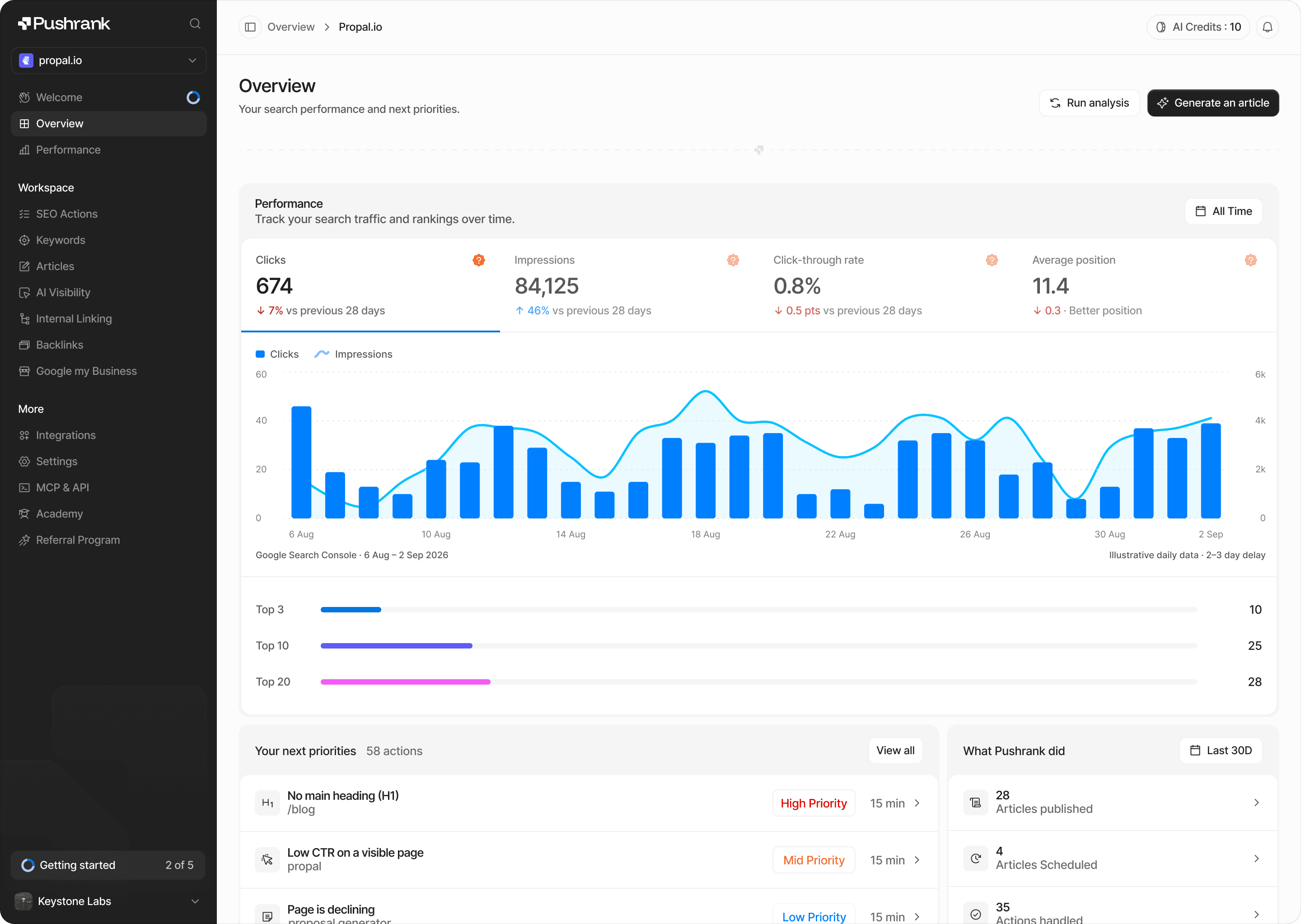
At Pushrank available at pushrank.io, we made a different choice: a daily prioritized action plan telling you what to do first, SEO actions updated every week and access to your data from Claude or ChatGPT through MCP, starting at 74 euros excluding tax monthly.
In this article we share our complete Sedestral review.
What Is Sedestral?

Sedestral is a French SEO platform built on a particular principle: rather than giving you an interface to operate yourself, it distributes the work across six autonomous AI agents, each specialized on one dimension of search optimization.
That architecture is its genuine distinction. Where most tools hand you raw data to interpret, Sedestral assigns each agent an execution scope and runs them together, in the manner of a small consulting team.
The six agents cover blog content, page and product optimization, competitive visibility and AI tracking, backlink acquisition, indexing and technical audits, and creative asset generation.
Its operation assumes a connection to your real environment. The tool links to your site and your Google Search Console, which lets it work from your actual data rather than third-party estimates.
In practice, the cycle runs as follows. The tool analyzes your site and your competitors, identifies gaps in your topical coverage, builds a keyword strategy, writes the corresponding content with integrated images, then publishes directly to your blog.
It then tracks indexing and rankings on the content produced.
Its target audience is clearly defined: e-commerce operators, agencies and lean marketing teams that have committed to SEO as an acquisition channel without the resources to execute it consistently.
The commercial positioning is explicit. Sedestral presents itself as the accessible alternative to the classic combination of an analysis platform like Semrush and a writing tool like Surfer, consolidated into one subscription.
Two specificities deserve highlighting.
Product page optimization addresses a need few tools handle directly, despite affecting every online store with a substantial catalogue.
AI visibility tracking, covering ChatGPT, Gemini, Claude and other assistants, remains uncommon at this price point.
One final contextual note. Sedestral carries genuine industry recognition in France, being recommended by Abondance and rated 4.7 by Blog du Modérateur, which distinguishes it from newer tools with no verifiable track record.
What Features Does Sedestral Offer?
The platform organizes around six agents, each covering a distinct scope. Here is what each module actually delivers.
The Blog agent

This is the central module and the one structuring the offering. The agent analyzes topics, builds a keyword strategy, writes structured articles, integrates royalty-free or generated images, then publishes directly to your blog.
Volumes range from 30 articles monthly on Lite to 200 on Avancé.
User feedback converges on one point: the writing quality exceeds a generic ChatGPT output, which stems from the semantic enrichment applied before drafting.
The Optimization agent

This one works on what you have already published rather than producing new material. It identifies underperforming pages, enriches their semantic field and adjusts their structure.
It also covers product pages, with volumes from 75 to 500 optimizations monthly depending on your tier.
That product dimension deserves emphasis. For an e-commerce site with a substantial catalogue, where each listing is a potential entry point, this work typically goes undone for lack of time.
The Visibility agent
This module covers two distinct functions.
Competitor tracking, from 15 to 50 competitors monitored depending on your tier, comparing shared keywords, content quality, technical performance and backlink profiles.
AI visibility tracking, from 30 to 200 tracked queries, monitoring whether your site appears in responses from ChatGPT, Gemini, Claude and other assistants. This dimension will grow mechanically in importance as searches migrate toward conversational engines.
The Backlinks agent
This module handles acquisition, not merely analysis, and it is included across all three tiers.
That inclusion is unusual at this price level, since most platforms either exclude link building entirely or charge for it separately.
The Indexing agent
It runs technical SEO audits, from 10 to 60 monthly depending on your tier, examining structural issues and proposing fixes.
It also tracks indexing on the content created, verifying that Google has registered it and identifying which keywords it ranks for.
The Creative agent
Available from the Standard tier upward, it generates 100 AI images monthly to accompany your content.
Note its absence from the Lite tier, which means entry-level subscribers rely on royalty-free libraries.
The collaborative editor
An intelligent editor lets you rework produced content before publication, with real-time optimization suggestions. The collaborative dimension suits teams validating text across several reviewers.
Search Console integration
The tool connects to your Google Search Console, which lets it work from your real data rather than third-party estimates. That matters, since gaps between estimated and measured figures are considerable on low-traffic pages.
What the feature set does not cover
One point deserves stating. Sedestral executes a broad scope, but the tool does not prioritize your actions day to day. You have agents working, without a plan telling you where to start this week.
That is precisely what we built at Pushrank available at pushrank.io, with a prioritized daily action plan and SEO actions updated weekly.
How Much Does Sedestral Cost?
Three plans make up the offering, all without commitment. Here is the monthly breakdown.
Table: Sedestral pricing
| Criterion | Lite | Standard | Avancé |
|---|---|---|---|
| Monthly price | 119 € | 239 € | 499 € |
| Sites or languages | 2 | 6 | 20, adjustable |
| Users included | 2 | 4 | 6 |
| Blog articles | 30 | 80 | 200 |
| Page or product optimizations | 75 | 200 | 500 |
| Competitors tracked | 15 | 25 | 50 |
| AI visibility queries | 30 | 75 | 200 |
| SEO audits | 10 | 30 | 60 |
| AI images | Not included | 100 | 100 |
| Backlink acquisition | Included | Included | Included |
| Onboarding | One expert session | Session plus priority support | Dedicated expert |
| White label | No | No | Yes |
As the table shows, Lite at 119 euros already covers a complete scope with 30 monthly articles, 75 optimizations and 10 audits. It includes an expert onboarding session, which genuinely eases the start.
Standard at 239 euros roughly doubles every volume and adds the Creative agent with 100 AI images. Its allowance of 6 sites or languages makes it the natural fit for a multilingual e-commerce operation.
Avancé at 499 euros explicitly targets agencies, with white labeling, client reporting, a dedicated expert and site capacity adjustable up to 20.
Two points deserve attention. The cost per site becomes competitive as you move up tiers, and the human onboarding included from entry level remains uncommon at this price point.
At Pushrank available at pushrank.io, we start at 74 euros excluding tax with 30 articles and a prioritized daily action plan.
What Are the Limits of Sedestral?
Several constraints deserve stating before you commit.
- A high entry price at 119 euros, among the steepest in its category
- No permanent free plan, only a trial
- A quota system on each agent, requiring monthly monitoring
- No AI images on the Lite tier
- Only two sites on entry level, restrictive for multi-project operators
- Automated publishing poorly suited to regulated sectors
- Broad scope without daily prioritization of actions
- Limited public reviews, with modest feedback volume so far
Among these, the entry price is the most concrete barrier. At 119 euros monthly, Sedestral sits well above several direct competitors, which effectively excludes operators testing SEO before committing.
The Lite tier is also limited to two sites, a real constraint for an agency or multi-project operator who will need to move to Standard at 239 euros sooner than expected.
The quota system warrants attention. Each agent carries its own monthly allowance: articles, optimizations, audits, competitors tracked, AI queries. These counters deplete independently, which demands monitoring and creates situations where one allowance runs out while others sit unused.
The absence of daily prioritization is the most structural limitation in our view. Sedestral executes many things competently, but the tool does not tell you where to start this week. You have agents working, without a plan ordering your priorities.
That distinction matters more than it appears. Publishing 80 monthly articles on a site with an unresolved indexing problem amounts to filling a leaking bucket.
Note finally that the volume of public reviews remains modest compared to established players, which limits the available perspective on results sustained over time.
At Pushrank available at pushrank.io, we offer a subscription with no per-agent quotas and a prioritized daily action plan.
Pushrank vs Sedestral
Both platforms automate SEO with AI agents, but they do not solve the same problem. Sedestral executes tasks. Pushrank tells you what to do. Here is the comparison.
| Criterion | Pushrank | Sedestral |
|---|---|---|
| Entry price | 74 € excl. tax monthly | 119 € monthly |
| Daily action plan | Yes, prioritized every day | No |
| Guided SEO actions | Database updated weekly | No |
| Quota system | No | Yes, per agent |
| Articles included | 30 monthly | 30 on Lite |
| MCP access | Yes, from Claude or ChatGPT | No |
| Search Console tracking | Real data | Integrated |
| AI visibility | ChatGPT, Claude, Gemini | 30 to 200 queries by tier |
| Technical audit | Included, cross-referenced with traffic | Capped monthly audits |
| Backlink acquisition | Backlink feature | Included on all tiers |
| AI images | No | 100 on Standard and above |
| Dedicated consultant | Optional at 500 € excl. tax | Included on Avancé |
As the table shows, the decisive gap is prioritization. Sedestral puts six agents to work, which produces a great deal. But producing a great deal is not the same as producing what matters.
At Pushrank, our daily action plan tells you precisely what to handle first, and our SEO actions updated every week form a guide for outranking your competitors rather than a volume to consume.
The second gap concerns quotas. Sedestral runs independent counters per agent, depleting at different rates. Our subscription carries none.
The third is the entry price, at 74 euros excluding tax against 119.
Two points go to Sedestral and deserve stating plainly: its included backlink acquisition and its white labeling for agencies have no equivalent on our side.