Why keyword mapping matters
A keyword map follows one rule: every group of keywords that calls for the same answer belongs to one page, and one page only. The resulting table, often a plain spreadsheet, does three jobs.
- It prevents keyword cannibalization. When two of your pages target the same query, they compete for the same spot and neither performs as well as it could.
- It exposes gaps. A keyword group with no page assigned is content you still need to create.
- It makes briefs easier. Every writer knows the primary keyword, the variants and the intent the page has to serve.
How to build a keyword map
1. Collect your keywords
Start from your keyword research, then add the queries your site already gets. In Search Console, the Performance report lists them under the Queries tab.
2. Group them by intent
Two keywords belong together when they call for the same answer. A practical test: if the same pages rank at the top for both queries, one page can target both. If the results look clearly different, plan two pages.
3. Assign each group to a URL
Use an existing page if it already serves the intent, otherwise mark a page to create. For each row, record the URL, primary keyword, variants, intent and current position.
4. Check the map against real data
In Search Console, filter the Performance report on a query, then open the Pages tab. If several of your URLs get impressions for it, your map and Google's reading of your site don't match.
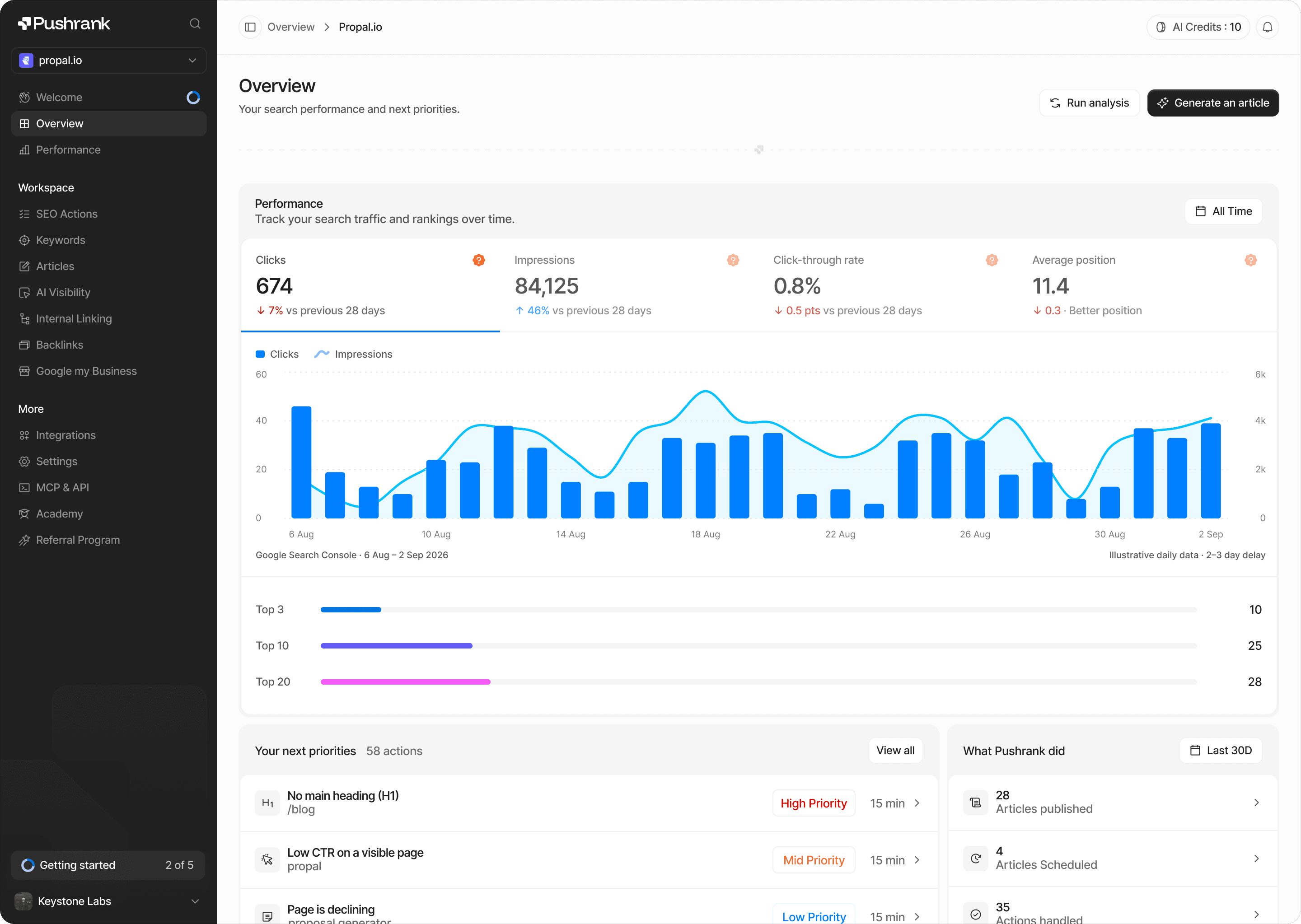
Once your map is in place, Pushrank runs that check every night when Search Console is connected. It flags each query where two or more of your pages get at least 20 impressions each, and tells you which page to keep.
Common mistakes
- One page per variant. "Espresso grinder" and "espresso grinders" call for the same answer. One page is enough.
- Ignoring intent. Pointing an informational query at a product page, or the reverse, works against what Google already shows for that query.
- Mapping once and forgetting it. Pages get created, merged and deleted, and queries shift. Update the map whenever your content changes.
- Stopping at the spreadsheet. The map says which page targets what. Your internal links then need to point to that page, with consistent anchor text.
Example
A coffee equipment store sells espresso grinders. Search Console shows the query "espresso grinder" splitting its impressions between the category page and a buying guide. The store gives the commercial query to the category page, refocuses the guide on how to choose a grinder, and links from the guide to the category.
| URL | Primary keyword | Variants | Intent |
|---|---|---|---|
| /espresso-grinders | espresso grinder | burr grinder for espresso, home espresso grinder | commercial |
| /blog/how-to-choose-espresso-grinder | how to choose an espresso grinder | flat vs conical burr, grind size for espresso | informational |
| to create | quiet espresso grinder | low noise coffee grinder | commercial |
The third row has no page yet. That's the next piece of content to produce.