Most SEO work fails before a single word is written, at the moment the keyword list gets built. Teams pick terms that describe what they sell, sort them by search volume, and go after the biggest numbers. Six months later they are ranking for nothing, or ranking for queries that bring visitors who were never going to buy.
The problem is that search volume is the least useful number in keyword research. A term with 10,000 monthly searches that you cannot realistically rank for is worth nothing, and a term with 90 searches from people ready to purchase can outperform it on revenue. The decision is never "which keyword is biggest", it is which keyword can we win, and is it worth winning.
Three questions settle that. What is the intent behind the query: is the person learning, comparing or buying? Can we compete: who currently ranks, with what authority and what depth of content? Does it convert: would this visitor ever become a customer? A keyword that fails any one of those three is not a keyword, it is a distraction.
There is also a shift worth factoring in going into 2027. Informational queries increasingly get answered directly in AI results and answer boxes, which means the keywords worth targeting are moving toward commercial and comparison intent, where a click still has value and where being cited as a source actually matters.
This guide covers the full method: how to build an initial list, how to read intent correctly, how to assess competition honestly, how to prioritise by business value rather than volume, and how to map keywords to pages so you never cannibalise yourself.
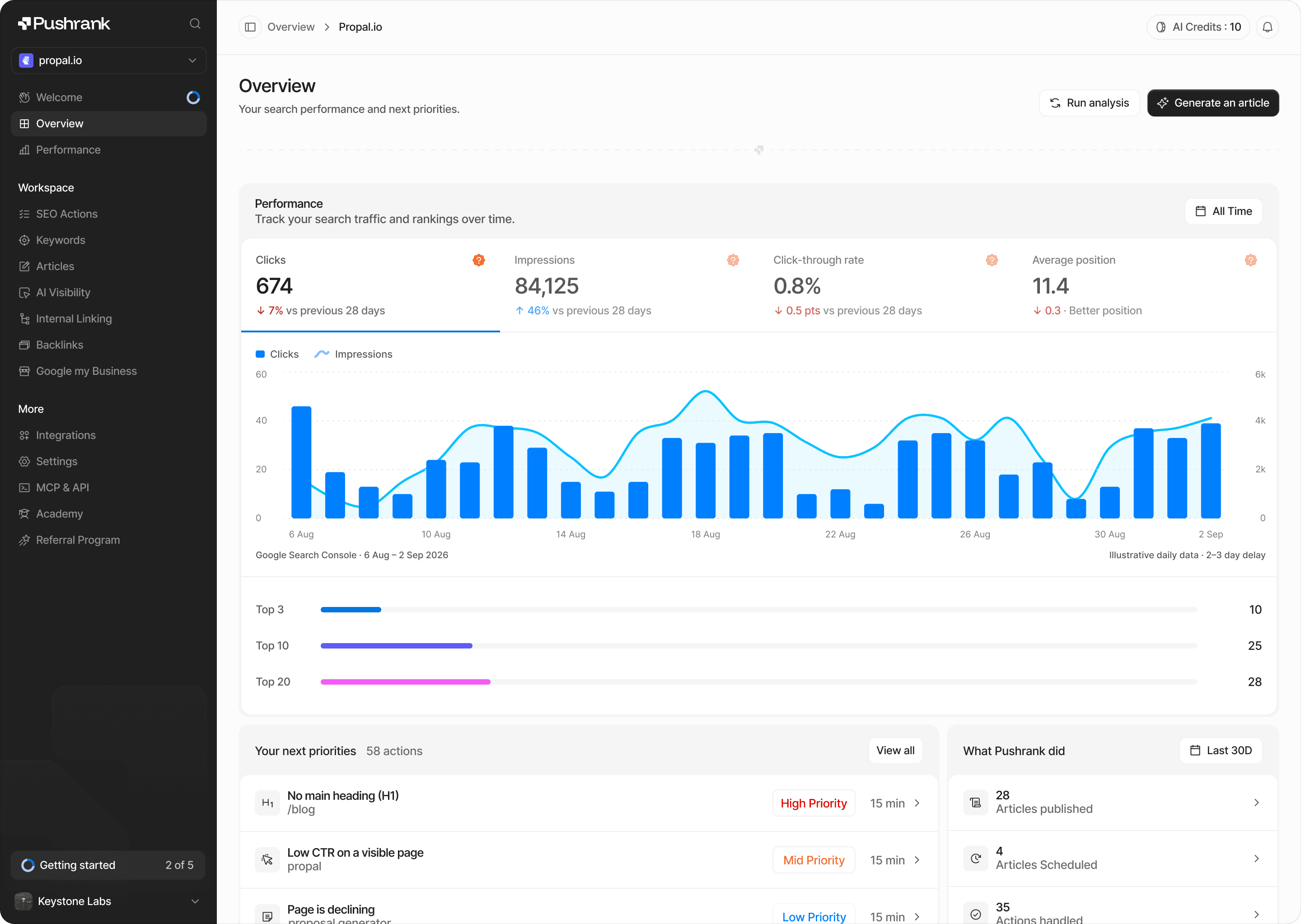
And if you would rather not run this analysis by hand, Pushrank does the work of an SEO for you: it connects to Search Console, identifies the queries you can actually win, detects cannibalisation between your own pages, and turns the whole thing into a prioritised action plan updated every week.
What makes a good SEO keyword?
A good keyword is not the one with the most searches. It is the one that sits at the intersection of three conditions: someone is searching for it, you can realistically rank for it, and the person searching could become a customer. Fail any one of those and the keyword is not worth a page, however impressive its volume looks in a spreadsheet.
Clear and single search intent
Intent is the first filter, because it determines what kind of page can rank at all. Four types matter. Informational queries want to learn ("what is a merchant of record"). Navigational queries want a specific site. Commercial queries are comparing before buying ("best GEO tools", "Semrush vs Ahrefs"). Transactional queries are ready to act ("buy", "pricing", "free trial").
The practical rule: a keyword is only usable if its intent is unambiguous. If the current results page mixes product pages, blog posts and video, Google itself has not settled the intent, and you are entering a lottery. Read the SERP before deciding anything: it tells you exactly what format Google expects, and your page has to match that format rather than argue with it.
Realistic competition
This is where most lists collapse. A keyword you cannot win is not an opportunity, it is a year wasted. Assess competition by actually looking at who ranks: are the top ten results dominated by domains with far more authority than yours, or are there forums, thin pages, outdated articles and small sites in the mix? The second case is an opening.
Difficulty scores from SEO tools are useful as a first sort, never as a verdict. They measure backlinks, not content quality or freshness, and they routinely miss the fact that the top result is a four-year-old page nobody has updated.
Genuine business value
Ask one question about every keyword: would this visitor ever buy from us? A SaaS company ranking first on "what is SEO" gets traffic and no pipeline. The same company ranking third on "best SEO tool for agencies" gets fewer visitors and far more revenue.
This is why a term with 90 monthly searches can be worth more than one with 10,000. Commercial and transactional queries convert at a different order of magnitude, and they are also the queries where a click still exists, since informational answers are increasingly resolved directly in AI results and answer boxes.
Sufficient specificity
Broad head terms are expensive and vague. Long-tail keywords, typically three to six words, carry lower volume but much higher clarity. "Running shoes" tells you nothing. "Running shoes for flat feet marathon" tells you the product, the problem and the use case, which means the page practically writes itself and the visitor arrives already qualified.
Specificity also compounds: a cluster of precise pages builds topical authority on the broad term you could not have attacked directly.
Fit with an existing page, or a page worth creating
Every keyword needs one page, and one page only. Two pages targeting the same query compete against each other, split their signals and both underperform. Before adding a keyword to your list, decide which page owns it, or whether it justifies a new one.
Durability
Finally, prefer keywords with stable or growing demand over spikes. Check the trend over five years, not twelve months: a seasonal curve is not growth, and a single peak is a trend that has already passed.
A keyword meeting all six criteria is rare. Three or four is usually enough to justify the work.
How to build your initial keyword list?
The goal at this stage is coverage, not precision. You are collecting candidates; filtering comes next. Work through these sources in order.
Start with your own vocabulary. List how you describe what you sell, then list how your customers describe it. These are rarely the same words, and the customer version is the one people search. Sales calls, support tickets and onboarding emails are the best source.
Mine your Search Console data first. Before any tool, look at the queries you already receive impressions for. Pages ranking on page two with real impressions are the fastest wins available to you, and they cost nothing to find.
Read your competitors' pages. Take the three or four competitors who rank where you want to be, and list the terms their titles, headings and URLs are built around. You are not copying their strategy, you are mapping the vocabulary of your market.
Use autocomplete and related searches. Google's suggestions, People Also Ask boxes and related searches at the bottom of the page are real queries, grouped by the engine itself. They reveal how Google connects subtopics, which matters for structuring clusters later.
Expand with a keyword tool. Semrush, Ahrefs or Google Keyword Planner turn your seed list into hundreds of variations with volume and difficulty attached. Export everything at this stage, filter afterwards.
Collect question-based queries separately. "How", "what", "why", "is", "best", "vs". These feed answer boxes and AI citations, and they map directly onto article headings.
Add your commercial terms deliberately. Comparisons, alternatives, pricing, reviews, "for [use case]". These are the lowest-volume, highest-value queries, and most teams forget them.
Dump it all into one sheet. Keyword, source, volume, nothing else yet. Judgment comes in the next step.
How to analyse search intent?
Intent cannot be guessed from the words alone. It has to be read off the results page, because the SERP is Google's own answer to the question "what does this person want?". Here is how to read it properly.
Search the query yourself, in an incognito window. Set the right country and language. What ranks is the brief: Google has already decided which format satisfies this query, and your page has to match it rather than argue with it.
Identify the dominant page type. Blog articles mean informational intent. Product or category pages mean transactional. Comparison and listicle pages mean commercial investigation. If nine of ten results are articles, a product page will not rank, no matter how good it is.
Read the SERP features. A featured snippet signals a question expecting a direct answer. Shopping results signal purchase intent. A map pack signals local intent. Videos signal that people want to be shown, not told.
Check the format of what ranks. Long guide or short answer? Table or prose? Listicle with a number in the title? Match the dominant format, since it reflects what users actually engage with.
Look for mixed intent. If the first page mixes product pages, articles and videos, Google has not settled the intent. These queries are volatile and expensive to chase. Deprioritise them.
Spot the commercial modifiers. "Best", "vs", "alternative", "review", "pricing", "for [use case]" are commercial investigation signals. These are the highest-value queries for most businesses and the ones where a click still exists.
Classify every keyword in your sheet. Add one column: informational, commercial, transactional, navigational. This single column drives everything downstream, from page type to internal linking.
Re-check intent periodically. SERPs shift. A query that was informational last year may now return product pages.
How to assess keyword difficulty?
Difficulty is the step most teams skip, and it is the one that decides whether your next six months produce rankings or nothing at all. The question is not "is this keyword hard?" but "is it hard for us?", which is a different calculation for a site with 50 backlinks and one with 5,000.
Start with the difficulty score from your SEO tool, but treat it as a first sort rather than a verdict. These scores are calculated mainly from the backlink profiles of the ranking pages. They know nothing about content quality, freshness, or whether the top result is a four-year-old article nobody has touched. A score of 45 can be unwinnable in one niche and easy in another.
Then do the part that actually matters: open the results page and look at it. Three signals tell you more than any metric. First, who ranks: if the top ten are all established domains with far more authority than yours, the keyword is out of reach for now. If you see forums, Reddit threads, thin pages, outdated articles or small sites, there is an opening. Second, how good the content is: read the top three results honestly and ask whether you can produce something clearly better, not marginally different. Third, how old it is: a page last updated in 2023 ranking first on a topic that has moved is an invitation.
Compare your own position fairly. Your domain authority, your topical coverage on the subject and your existing backlinks set what you can realistically attack. A site with no authority on a topic does not win a competitive head term, whatever the content quality.
The practical approach: attack long-tail and commercial queries first, build topical depth, and let the head terms become reachable later. Ranking fifth on a term you can win beats ranking fortieth on one you cannot.
How to prioritise your keywords?
You now have a filtered list and limited resources. Prioritisation is simply deciding what gets written first, and the order matters more than most teams realise: the wrong sequence delays results by months.
Score each keyword on three axes rather than one. Business value: would this visitor become a customer? Winnability: can you realistically rank in the next three to six months? Volume: is there enough demand to justify the work? Rate each from one to three, multiply, and sort. A commercial keyword you can win beats a high-volume informational term every time, even when the volume gap looks dramatic.
Then apply a sequencing rule that overrides the score. Start with the quick wins hiding in Search Console: queries where you already rank between positions 5 and 20 with real impressions. These pages exist, they already have signals, and a rewrite plus internal links can move them into the top five in weeks. This is the cheapest traffic you will ever get, and almost everyone skips it to write new articles instead.
Next, take your commercial and comparison queries. Lower volume, higher conversion, and the segment where clicks still exist now that informational answers are increasingly resolved inside AI results and answer boxes.
Then build the informational clusters that support those commercial pages. Each cluster reinforces the topical authority that makes the money pages rank, so the order is not interchangeable: supporting content after the page it supports, not before.
Leave the head terms for later. They become reachable once the cluster around them exists.
One final discipline: cap your list. Thirty keywords executed properly produce more than three hundred sitting in a spreadsheet. If this analysis is work you would rather not run manually, Pushrank builds the prioritised plan from your own Search Console data and refreshes it weekly.
How to map keywords to pages?
Mapping is the step that turns a keyword list into a site structure. Skip it and you end up with pages competing against each other, which is the single most common self-inflicted SEO problem.
One page, one primary keyword
Each page owns one primary keyword and the variations that mean the same thing. "AI thumbnail maker", "AI thumbnail generator" and "AI thumbnail creator" are the same intent and belong on one page. "AI thumbnail maker" and "YouTube thumbnail size" are different intents and need different pages.
The test is simple: if two keywords would produce substantially the same page, they share a page. If they would produce different content, they get separate pages.
Match intent to page type
Intent decides the format, not your preference. Transactional and commercial queries go to product, pricing, comparison or category pages. Informational queries go to articles, guides and glossary entries. Putting an informational keyword on a product page, or the reverse, is a guaranteed non-ranking, however strong the page is.
Build the map as a document
One row per page: URL, primary keyword, secondary keywords, intent, page type, and current position if the page exists. This single sheet becomes the reference for your whole content plan, and it prevents the most expensive mistake: writing a page for a keyword you already cover.
Check for cannibalisation
Before adding any page, search site:yourdomain.com plus the keyword. If an existing page already targets it, improve that page instead of creating a new one. Two pages chasing the same query split their backlinks, their internal links and their relevance signals, and both end up underperforming.
Cannibalisation is rarely deliberate: it accumulates quietly as a site grows. This is one of the checks Pushrank runs automatically across your site, flagging the conflicts before they cost you positions.
Plan the internal linking at the same time
Decide, as you map, which pages link to which. Supporting articles link to the commercial page they reinforce, and that page links back to the cluster.
Frequently asked questions about keyword research
How many keywords should I target?
One primary keyword per page, plus the variations that mean the same thing. At site level, start with 20 to 30 keywords properly executed rather than 300 sitting in a spreadsheet. Depth beats breadth, especially on a young site.
Is search volume still the main criterion?
No, and it never really was. A term with 90 monthly searches from buyers outperforms one with 10,000 from people who will never purchase. Rank your list by business value and winnability first, volume third.
What is a good keyword difficulty score?
There is no universal number. A score of 45 can be unwinnable in one niche and easy in another, because these scores measure backlinks rather than content quality or freshness. Open the results page and judge who actually ranks instead of trusting the metric.
Should I target long-tail or head keywords?
Long-tail first, almost always. They are more specific, less competitive, convert better, and the cluster you build around them is what eventually makes the head term reachable. Attacking a head term with no topical authority is the most common way to waste six months.
How do AI answers change keyword research?
They shift value toward commercial and comparison intent. Informational queries are increasingly resolved directly in AI results and answer boxes, so the click disappears even when you rank. Queries with "best", "vs", "alternative", "pricing" and "review" are where a visit still exists.
How often should I redo this?
Review quarterly, and re-check intent on your priority keywords, since SERPs shift. Check Search Console monthly for queries rising into positions 5 to 20, which are your cheapest wins.