SEO rests on four fundamentals, and everything else is a variation on one of them: technical foundations that let search engines crawl and render your pages, keyword and intent research that decides what each page should answer, content and on-page optimisation that make that page the best available answer, and authority built through links and reputation that tells search engines the answer can be trusted.
That framework has not changed in fifteen years. What has changed is the standard required on each one. A crawlable site was once enough to rank; today Core Web Vitals, rendering behaviour and structured data all affect what gets indexed and how it is presented. Keyword research used to mean matching strings; now it means identifying intent precisely enough to earn one page per query rather than three pages competing with each other. And with AI-generated answers now sitting above the traditional results on many queries, being the best answer matters more than being the tenth-best page.
The mistake most sites make is not ignorance of these pillars. It is spending months on one while another quietly undermines the whole site: writing sixty articles while the architecture cannibalises half of them, or chasing links to pages search engines cannot render properly.
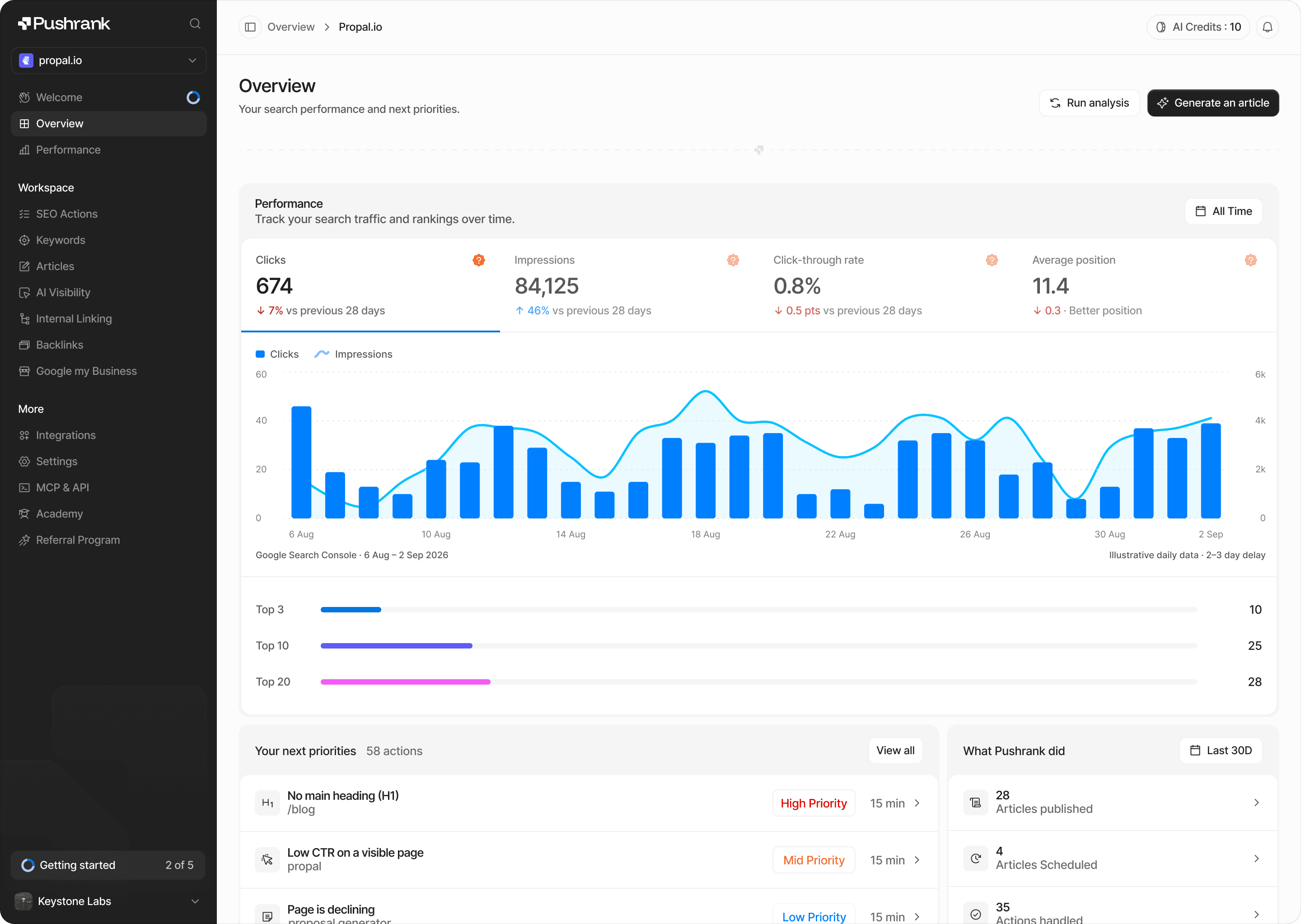
Seeing which pillar is actually holding you back requires data rather than instinct, which is exactly what Pushrank is built for: it crawls your site, connects to Search Console, and turns that into a prioritised action plan instead of a dashboard you still have to interpret.
Let's take each fundamental in turn.
How do search engines actually work?
Every SEO decision you make targets one of five stages. Knowing which stage your problem sits at is what stops you from writing more content when the real issue is that nothing is being indexed.
Discovery
Crawling
Rendering
Indexing
Ranking and serving
Discovery is how search engines find your URLs in the first place: through links from pages they already know, through your XML sitemap, and through redirects. A page nobody links to and no sitemap declares may simply never be found. This is why orphan pages are a structural problem rather than a detail.
Crawling is the moment a bot actually requests the page, following the rules set in your robots.txt. Every site gets a finite amount of crawl attention, and a large site that wastes it on faceted URLs, parameters and duplicates leaves its important pages visited rarely. Crawl budget is only a real constraint on large sites, but when it bites, it bites hard.
Rendering is where the HTML is processed and JavaScript is executed, often in a second pass that lags behind the initial crawl. If your content, your links or your titles only appear after JavaScript runs, there is a window during which search engines see an empty shell. This is the most common silent failure on modern frameworks, and the one site owners discover last.
Indexing is the storage stage: the page is analysed and filed with its content, its canonical URL, its structured data, its language and its relationship to similar pages. Not everything crawled gets indexed. Thin content, near-duplicates and pages the engine judges redundant are dropped here, which is why "crawled, currently not indexed" is such a frequent Search Console status.
Ranking and serving is the final stage. For a given query, the engine selects candidate pages from its index and orders them using hundreds of signals: relevance to intent, content quality, authority, user location, device and language. Increasingly, it also generates a direct answer above those results, drawing on the same indexed pages.
Two consequences follow, and they matter more than any individual tactic. A failure at any stage cancels everything downstream: the best article in your niche ranks nowhere if the page is not rendered, not indexed or blocked in robots.txt. And you can verify each stage yourself, since Search Console reports what was crawled and indexed, the URL Inspection tool shows the rendered version, and your server logs show what bots actually requested.
What are the technical fundamentals of SEO?
Technical SEO is not a specialist discipline you add later. It is the layer that determines whether anything else you do has a chance of working. Here is what it covers and why each item matters.
Element | What it does | Why it matters |
|---|---|---|
Crawlability | robots.txt, internal links, no crawl traps | A page that is never requested is never indexed |
Indexability | noindex tags, canonicals, HTTP status codes | Controls which pages are allowed to enter the index |
XML sitemap | Lists the URLs you want indexed | Speeds up discovery, especially on large or new sites |
Site architecture | Depth, categories, internal linking | Pages more than three clicks deep get crawled far less often |
URL structure | Readable, stable, logical paths | Reduces duplication and clarifies hierarchy |
Canonicals | Designates the reference version of a page | Prevents duplicate content from splitting signals |
Redirects | 301 for permanent moves, no chains | Preserves accumulated authority during changes |
HTTPS | Encrypted connection | A baseline requirement, not an advantage |
Mobile rendering | Responsive layout, mobile-first indexing | Google indexes the mobile version of your site, not the desktop one |
Core Web Vitals | LCP, INP, CLS | Affects user experience and acts as a tiebreaker between comparable pages |
JavaScript rendering | Server-side or pre-rendering | Content visible only after JS may be missed or delayed |
Structured data | Schema.org in JSON-LD | Enables rich results and clarifies entities for AI answers |
Hreflang | Language and country targeting | Prevents the wrong market's page from ranking |
Pagination | Clean, crawlable navigation | Keeps deep catalogue pages reachable |
Log analysis | What bots actually request | The only direct evidence of how crawl budget is spent |
Three items in this table cause most of the damage.
Canonicals and duplication quietly split your signals. Two URLs serving near-identical content compete with each other, and neither accumulates enough relevance to win. On ecommerce sites with filters and parameters, this alone can account for the majority of wasted crawl budget.
JavaScript rendering is the modern blind spot. A site built on a client-side framework can look perfect in a browser while showing search engines an empty page. Always check the rendered HTML, not the source you wrote.
Site depth is the one nobody measures. Pages buried four or five clicks from the homepage are crawled rarely and ranked poorly, regardless of how good the content is. Flattening your architecture is often the cheapest technical win available.
Running these checks manually across a full site is where most audits stall. Pushrank crawls the site and surfaces which of these issues actually affect your indexed pages, rather than handing you a list of four thousand warnings to triage yourself.
How does keyword research fit into SEO fundamentals?
Keyword research is the step that decides what every other effort is aimed at. Skip it and you write content nobody searches for; rush it and you build three pages competing for the same query. It sits between understanding your market and producing anything at all.
It starts with intent, not volume. A keyword is only useful if you can tell what the person typing it actually wants. "Running shoes" and "best running shoes for flat feet" look related and demand completely different pages: one is a category, the other is a guide. The search results themselves answer this question. If the top ten are all comparison articles, that query wants a comparison article, and no amount of optimisation will rank a product page there.
Volume and difficulty come second. They tell you whether a keyword is worth the effort, not whether it is relevant. A term with 20,000 monthly searches that you have no chance of ranking for is worth less than four long-tail queries with 150 searches each that you can win this quarter. On a young site, difficulty matters far more than volume.
Clustering turns a list into a plan. Five hundred keywords is not a strategy. Grouped by intent, the same list becomes forty topics, each mapping to exactly one page. This is the step that enforces the one-keyword-one-page rule, and it is where most sites save themselves months of wasted writing. Doing this properly from the start is far cheaper than untangling it later, which is why keyword research and mapping belong at the beginning of a content plan rather than after thirty articles are live.
Mapping prevents cannibalisation. Once each cluster has an owner page, you can see immediately when a new article would overlap with something you already published. Without that map, you discover the problem months later, when two of your own pages are trading places in the results and neither ranks well. Detecting keyword cannibalisation across an existing site is the cleanup version of this same discipline.
Research is continuous, not a one-off project. Queries change, competitors publish, intent shifts as a market matures. Reviewing your Search Console queries every quarter surfaces terms you already rank for accidentally, which is usually the cheapest growth available: a page sitting at position 12 for a query you never targeted needs an update, not a new article.
What are the off-page fundamentals of SEO?
Off-page SEO covers everything that happens outside your own site but still shapes how search engines judge it. In practice it comes down to one question: does the rest of the web treat you as a credible source?
Backlinks and why they still matter
A link from another site is a vote. It was the original ranking signal and it remains one of the strongest, because it is the hardest to fake at scale. Search engines use links both to discover pages and to estimate how much weight a page deserves relative to others covering the same subject.
Quality beats quantity, decisively
Ten links from respected sites in your field are worth more than a thousand from directories and link farms. What matters is the authority of the linking domain, its topical relevance to your subject, where the link sits on the page, and whether the surrounding content makes editorial sense. A contextual link inside a relevant article carries weight; a footer link on an unrelated site carries none.
Anchor text, used carefully
The clickable text tells search engines what the destination is about. Natural, varied anchors are the goal. Hundreds of identical exact-match anchors look manufactured, because they are, and this is one of the clearest patterns spam systems detect.
Digital PR and earned coverage
The most durable link building is not link building at all. Publishing original data, launching a free tool, or saying something quotable gives journalists and bloggers a reason to cite you. These links arrive on their own, from sites you could never have bought, and they keep arriving.
Brand mentions without a link
Being named repeatedly across your sector builds recognition even when no link is attached. This matters increasingly for AI-generated answers, which draw on how consistently an entity is described across sources rather than purely on link graphs.
Local signals
For businesses with a physical presence, consistency of name, address and phone number across directories, plus an actively managed business profile and genuine reviews, functions as the local equivalent of authority.
What to avoid
Bought link packages, private blog networks, mass guest posting on content farms and reciprocal link schemes all violate search engine guidelines. They can work briefly, and the recovery after a manual action or algorithmic devaluation costs far more than the links ever returned.
The practical approach for most sites: earn a few genuinely relevant links per quarter, and spend the remaining effort on content and technical foundations, where returns are more predictable.
How do you measure SEO performance?
SEO without measurement is guesswork with extra steps. The difficulty is not access to data, it is knowing which numbers mean something.
Start with impressions and clicks in Search Console. These are the only first-party figures you have on how search engines actually surface your site. Impressions tell you whether you are being shown, clicks whether you are being chosen. A page with rising impressions and flat clicks has a title and meta description problem, not a ranking problem.
Track average position by query, not site-wide. A global average position is close to meaningless, since it mixes a hundred unrelated terms. What matters is movement on the twenty to thirty queries that carry your business, and particularly anything sitting between positions 8 and 20, where a single content update produces the fastest returns.
Separate branded from non-branded traffic. Searches for your own company name tell you about brand awareness, not about SEO. Mixing them into one growth number hides whether your organic acquisition is actually working.
Follow indexed pages over time. If you publish forty pages and your indexed count rises by twelve, you have a technical problem that no amount of additional writing will solve.
Measure conversions, not sessions. A thousand visitors who never convert are worth less than eighty who do. Connect your organic traffic to whatever actually matters: signups, leads, sales.
Give it time. Most changes take six to twelve weeks before producing readable signal. Judging an update after four days leads to reverting things that were working.
Watch two new signals as well. How often your pages appear in AI-generated answers, and how much traffic arrives from AI assistants. Both are becoming material, and neither appears in traditional rank tracking.
What are the most common SEO mistakes?
Most sites that underperform are not missing a secret technique. They are repeating one of these, often for months, without realising it.
Mistake | Why it happens | What it costs you |
|---|---|---|
Publishing several pages for the same query | No keyword mapping before writing | Cannibalisation: your pages compete and none ranks well |
Writing without checking intent | Targeting the keyword instead of the SERP | A page that can never rank, whatever its quality |
Ignoring technical issues | Content feels more productive than fixes | Pages crawled rarely, rendered badly or never indexed |
Chasing volume over difficulty | Big numbers look more ambitious | Months spent on terms a young site cannot win |
Never updating existing pages | New content feels like progress | Your best assets decay while you write new ones |
Buying links | Impatience | Short-term gains, then a devaluation or a manual action |
Leaving pages orphaned | No internal linking plan | Pages search engines barely discover |
Judging results after two weeks | Pressure to show impact | Reverting changes that were starting to work |
Tracking site-wide average position | It is the default metric shown | A number that hides every meaningful movement |
Mixing branded and non-branded traffic | Easier to report one figure | Brand growth disguised as SEO performance |
Blocking resources in robots.txt | Old configurations left in place | Pages rendered incompletely by search engines |
Thin pages published at scale | Volume strategies | Crawl budget wasted, quality signals diluted |
Three of these cause most of the damage.
Cannibalisation is the quiet one. It never produces an error message: your site simply grows more slowly than the effort you put into it, because your own pages keep splitting their signals.
Neglecting updates is the most expensive by opportunity cost. A page already sitting at position 9 needs an hour of work to reach position 4. A new article needs weeks and may never rank at all.
Judging too early undoes the rest. Six to twelve weeks is the realistic window for a meaningful signal, and reverting at week two guarantees you never find out what worked.
Catching these across a full site is exactly what a structured SEO audit is for: the problems above are visible in the data long before they show up in your traffic.
How do you build an SEO strategy from these fundamentals?
A strategy is not a list of tactics. It is an order of operations, because the fundamentals depend on each other: fixing content before technical issues means publishing pages nobody can index.
Start with an audit, not with ideas. Before deciding anything, establish where you actually stand: what is indexed, what is crawled but ignored, which pages already rank, and which queries you appear for without having tried. This baseline determines everything that follows, and it almost always redirects the plan you had in mind.
Fix the blockers first. Anything preventing discovery, crawling, rendering or indexing comes before everything else. Not because it is glamorous, but because it caps the return on every other effort. If forty per cent of your pages are not indexed, your content problem is not a content problem.
Map your keywords before writing anything. Cluster your terms by intent, assign one page to each cluster, and compare that map to what you already have. You will usually find two things: existing pages competing for the same query, and obvious gaps with no page at all. Resolve the first before producing the second.
Improve before you create. Pages already ranking between positions 5 and 20 are your cheapest growth. They have proven they can rank; they need depth, freshness and internal links rather than replacement.
Then publish, one page per intent. With the map in place, each new article has a defined job and a defined place in your architecture, linked from the pages that already have authority.
Build authority last, and slowly. Earned links follow content worth linking to. Chasing them before you have that content is the most common waste of budget in SEO.
Measure in cycles, not in panic. Set a quarterly review against your baseline, using Search Console data as the reference rather than third-party estimates. Adjust the plan on what the data shows, not on what moved last week.
The sequence matters more than the speed. Sites that grow steadily are rarely doing anything exotic: they are doing these six things in this order, consistently, for long enough to compound.